



Every EU Knowledge syllabus starts with the same sentence — the EU is founded on two treaties — and every exam season, candidates lose points telling them apart. The confusion is understandable: both entered their current form on the same day, both get cited article-by-article, and their names differ by two words. But their division of labour is clean, and once you see it, treaty questions become geography: you know which map any article lives on.
This piece anchors our institutions-and-treaties series, alongside the three Councils, Article 288 (legal acts), Article 294 (the OLP) and the TFEU article explainers.
Two treaties, one Union, same rank
The foundational fact comes from the treaty text itself. Article 1 TEU (consolidated version, OJ C 202): the Union is "founded on the present Treaty and on the Treaty on the Functioning of the European Union", and — the clause exams love — "those two Treaties shall have the same legal value". The same article completes the historical picture: "The Union shall replace and succeed the European Community."
So there is no hierarchy between TEU and TFEU. Together they are primary law — "the Treaties" — the benchmark against which all secondary legislation (regulations, directives, decisions) is measured and, via Article 267, interpreted by the Court of Justice.
The division of labour
The TEU is the charter. Short — a few dozen articles — and constitutional in tone. It holds the Union's values (Article 2: human dignity, freedom, democracy, equality, the rule of law, human rights) and objectives (Article 3); the democratic principles; the institutional framework in outline — including Article 15 (European Council) and Article 16 (Council), Article 17 (Commission), Article 19 (Court of Justice); enhanced cooperation; the principles of external action and the entire Common Foreign and Security Policy; and the membership clauses — accession (Article 49) and the withdrawal clause (Article 50) that the United Kingdom activated.
The TFEU is the operating manual. Long — several hundred articles — and granular. It organises the Union's competences by category, then walks through the policies: the internal market and the four freedoms (Article 45, free movement of workers, lives here), agriculture, competition, transport, economic and monetary policy, employment, environment, energy and the rest. It details how the institutions function, defines the legal instruments (Article 288) and choreographs the legislative procedures (Article 294), the infringement mechanism (Article 258) and the budget.
A serviceable mnemonic: the TEU says what the Union is and wants; the TFEU says how it does it. Constitutional identity in one, operational detail in the other.
Where they came from — the Lisbon renaming
The pair is the product of the Treaty of Lisbon, in force 1 December 2009. Lisbon did not replace the treaties; it amended them. The existing Treaty on European Union (Maastricht, 1993) kept its name. The Treaty establishing the European Community — the lineal descendant of the 1957 Treaty of Rome — was renamed the Treaty on the Functioning of the European Union. And the failed Constitutional Treaty of 2004, which never entered into force, contributed substance but not form: there is no EU Constitution, only the two treaties.
That history explains the bracketed cross-references you see in the consolidated texts — "(ex Article 234 TEC)", "(ex Article 249 TEC)" — the old numbering of the renamed treaty, and a reliable clue in exam excerpts: an ex-TEC reference means you are reading the TFEU.
How to use the split when a question does not name the treaty
Plenty of questions give you an article number and no treaty, or a subject and no number. The division of labour between the two treaties is what lets you answer anyway.
The TEU is constitutional. Values, objectives, the democratic principles, the institutions in outline, enhanced cooperation, external action in principle, and the two membership clauses — accession under Article 49 and withdrawal under Article 50. If the subject is what the Union is and who belongs to it, look in the TEU.
The TFEU is operational. Competences and their categories, the internal market and the four freedoms, competition, the budget, and the procedures — including the ordinary legislative procedure and the actions before the Court. If the subject is how the Union does something, look in the TFEU.
Two anchors keep the split honest when a question tries to blur it. Article 1 TEU states that the two treaties have the same legal value: neither is subordinate. And the institutions appear in both — outlined in Articles 13 to 19 TEU, then given their detailed operation in the TFEU — so "the Commission is defined in the TFEU" and "the Commission is defined in the TEU" are both half-true, which is what makes the pair such reliable distractor material.
The exam patterns
Hierarchy bait. "The TEU prevails over the TFEU in case of conflict" — false; same legal value, by Article 1 TEU.
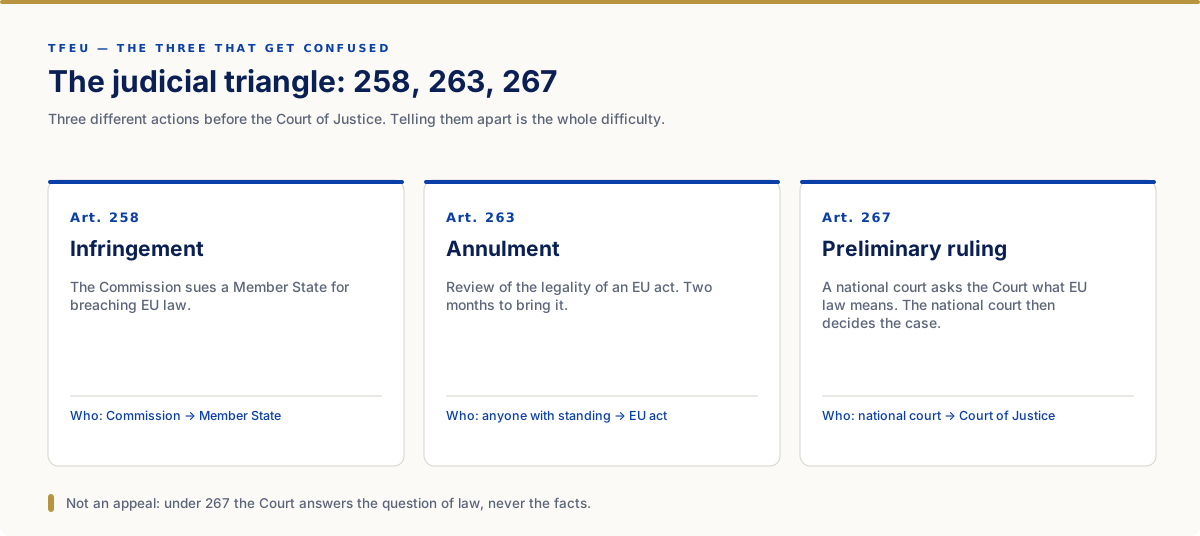
Location swaps. "The Union's values are listed in the TFEU" (no — Article 2 TEU); "the ordinary legislative procedure is laid down in the TEU" (no — Article 294 TFEU). Learn the handful of famous addresses: values 2 TEU, institutions 13–19 TEU, withdrawal 50 TEU; free movement 45 TFEU, infringement 258 TFEU, preliminary rulings 267 TFEU, legal acts 288 TFEU, OLP 294 TFEU.
Constitution bait. Any statement treating the "EU Constitution" as law in force. It never was.
Succession detail. The EU replaced and succeeded the European Community — post-Lisbon, statements about "the European Community" acting in the present tense are anachronisms.
Drill the addresses against free weekly EU Knowledge questions, and place treaty study inside your wider plan with the EPSO Preparation 2026 complete guide.
Get the free EPSO AD reasoning mock test
A realistic practice PDF — verbal, numerical and abstract reasoning. Enter your email and we send it right away.
Free. No spam. Unsubscribe anytime.