



When the Commission is called "guardian of the Treaties", Article 258 TFEU is the power behind the title. It is the procedure through which the Commission pursues a Member State that, in its view, has failed to fulfil an obligation under EU law — from an untransposed directive to a national rule that contradicts the Treaties. For the EPSO EU Knowledge test, it is prime material: a fixed sequence of steps, a discretionary "may", and two sibling articles to confuse it with.
The series also covers Article 107 (State aid), Article 191 (environment), Article 207 (common commercial policy), Articles 15 and 16 TEU (European Council and qualified majority) and Article 47 of the Charter (effective remedy).
This is part of our TFEU series — see also Article 45 (free movement of workers), Article 267 (preliminary rulings), Article 288 (legal acts) and Article 294 (ordinary legislative procedure).
The procedure, exactly as the treaty sequences it
The consolidated text (OJ C 202) packs the whole mechanism into two sentences, and every clause is testable.
Step 1 — the accusation and the right to be heard. If the Commission considers that a Member State has failed to fulfil an obligation under the Treaties, it delivers a reasoned opinion on the matter — but only "after giving the State concerned the opportunity to submit its observations". The State is heard before it is formally accused. In day-to-day practice this exchange opens with a letter of formal notice, the administrative first contact that frames the dispute.
Step 2 — the reasoned opinion. The Commission's formal statement of the breach, with a period for compliance. This is the pivot of the procedure: it fixes the scope of the case (the Commission cannot later expand it before the Court) and starts the clock.
Step 3 — the referral. If the State "does not comply with the opinion within the period laid down by the Commission, the latter may bring the matter before the Court of Justice of the European Union". Note may: referral is discretionary. Most infringement files never reach Luxembourg — they settle in the administrative phase, which is the procedure working as designed.
The 258 / 259 / 260 triangle
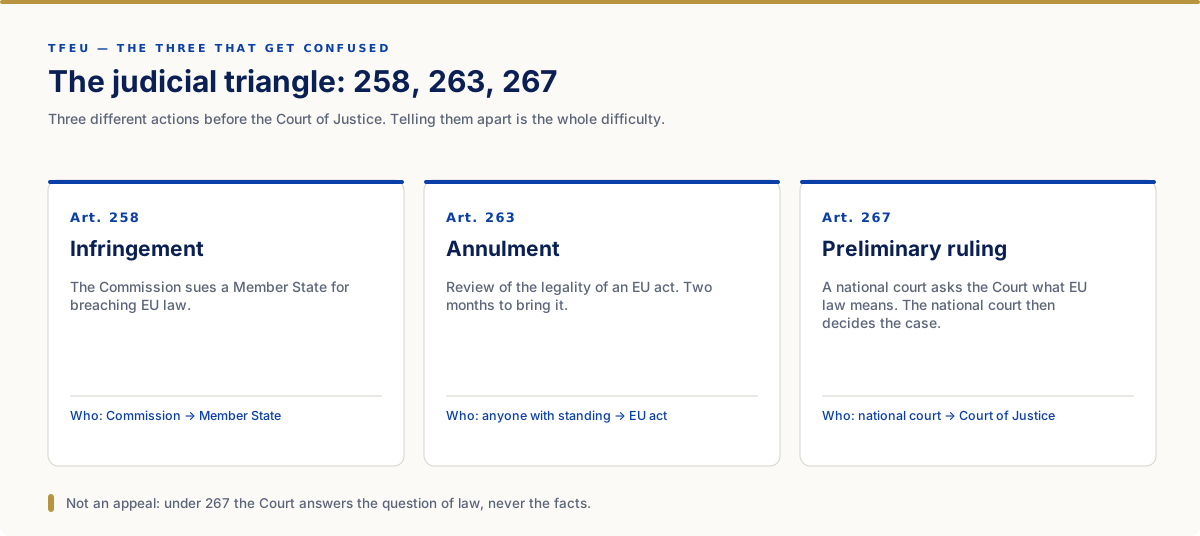
EPSO rarely tests Article 258 alone; it tests whether you can keep three neighbouring procedures apart.
| Article | Who acts | Against whom | What it delivers |
|---|---|---|---|
| 258 | Commission | a Member State | Declaration of breach by the Court |
| 259 | a Member State | another Member State | Same — but the applicant State must first go through the Commission |
| 260 | Commission | a Member State that ignored a judgment | Financial penalties — lump sum and/or penalty payment |
The two classic swaps: attributing fines to Article 258 (wrong — penalties arrive under Article 260, after a first judgment is not complied with), and forgetting that under Article 259 a Member State suing another must first bring the matter before the Commission, which gives its opinion before the case can proceed.
The two articles it is confused with
Article 258 is the Commission's route. Two neighbours do adjacent jobs, and swapping them is the most common way to lose a mark here.
Article 259 — the same action, different applicant. A Member State may bring another Member State before the Court for failing to fulfil a Treaty obligation, but it must first bring the matter to the Commission, which issues a reasoned opinion after hearing both sides. If the Commission does not deliver that opinion within three months, the case may go to the Court anyway. A statement that has one Member State suing another directly, with no prior step, describes something the Treaty does not provide.
Article 260 — what happens after the judgment. Article 258 ends with a declaration that the State has failed to fulfil an obligation. It is Article 260 that supplies the consequence: if the State does not comply with that judgment, the Commission may bring the case back and the Court may impose a lump sum or penalty payment. Fines are therefore never an Article 258 outcome — a distractor that attaches a financial penalty to the first judgment is wrong on the article, not on the policy.
The distractor patterns to expect
"Must" for "may". Any statement obliging the Commission to open proceedings or to refer to the Court contradicts the discretionary language of the article.
Skipped steps. "The Commission may bring a Member State directly before the Court of Justice" — false: the observations stage and the reasoned opinion come first, in that order.
Wrong actor. "The European Parliament may bring infringement proceedings against a Member State" — no: under 258 that power belongs to the Commission (and under 259, to another Member State). Individuals cannot bring infringement actions either; their route into EU law enforcement runs through national courts and Article 267.
Together, 258 and 267 answer the exam's favourite meta-question — who enforces EU law? — from both ends: the Commission polices states top-down; national judges, in dialogue with the CJEU, protect rights bottom-up.
Drill the pattern against real questions in the EU Knowledge practice hub, and place it inside your full campaign with the EPSO Preparation 2026 complete guide.
Get the free EPSO AD reasoning mock test
A realistic practice PDF — verbal, numerical and abstract reasoning. Enter your email and we send it right away.
Free. No spam. Unsubscribe anytime.