



If the EU legal order has a load-bearing wall, it is Article 267 TFEU. The preliminary ruling procedure is how a regulation means the same thing in Lisbon as in Ljubljana: national courts ask, the Court of Justice answers, and EU law stays uniform across twenty-seven legal systems. It is also a fixture of the EPSO EU Knowledge test, because its may/must structure produces perfect multiple-choice material.
And for the rights side of the same question — what an "effective remedy" means once the national court has its answer — see Article 47 of the Charter. The series also covers Article 107 (State aid), Article 191 (environment), Article 207 (common commercial policy) and Articles 15 and 16 TEU.
This is part of our TFEU series — see also Article 45 (free movement of workers), Article 258 (infringement), Article 288 (legal acts) and Article 294 (ordinary legislative procedure).
What the article establishes
Jurisdiction. The Court of Justice of the European Union has jurisdiction to give preliminary rulings on two things: the interpretation of the Treaties, and the validity and interpretation of acts of the institutions, bodies, offices or agencies of the Union.
Read that list carefully, because EPSO does. For the Treaties, the Court's power is interpretation only — primary law is the constitutional benchmark, so its "validity" is not in question. For secondary acts (regulations, directives, decisions — see Article 288), the Court rules on both validity and interpretation. A statement claiming the CJEU "reviews the validity of the Treaties" under Article 267 is wrong by design.
Who may refer. Where a question of EU law is raised before any court or tribunal of a Member State, that court may request a ruling if it considers a decision on the question necessary to give judgment. Referral at this level is a power, not a duty — the national judge decides whether the answer is needed.
Who must refer. Where such a question is raised before a court against whose decisions there is no judicial remedy under national law — a supreme court, a constitutional court acting as last instance — that court shall bring the matter before the CJEU. At the top of the judicial ladder, the option becomes an obligation, because a wrong reading there could never be corrected.
The custody clause. If the question arises in a case concerning a person in custody, the Court acts "with the minimum of delay". This final paragraph is less famous — which is exactly why it makes a good hard-mode exam question.
The trap EPSO never tires of: "it is not an appeal"
The most persistent misconception about Article 267 — among candidates and litigants alike — is treating it as an appeal to a higher court. Every structural feature says otherwise:
- The parties do not refer; the court does. Individuals cannot petition the CJEU directly under Article 267. The national judge suspends proceedings and formulates the question.
- The CJEU does not decide the case. It answers the abstract point of EU law. The national court then applies the answer to the facts and delivers the actual judgment.
- Nothing is overturned. There is no "quashing" of a national decision within the procedure — it is cooperation between courts, not hierarchy over outcomes.
Multiple-choice variants of this trap: "a party dissatisfied with a national ruling may appeal to the Court of Justice under Article 267" (false — no party appeal); "the CJEU decides the dispute between the parties" (false — the national court does); "the preliminary ruling binds only the referring court" (under-stated — the interpretation guides all courts applying the same provision).
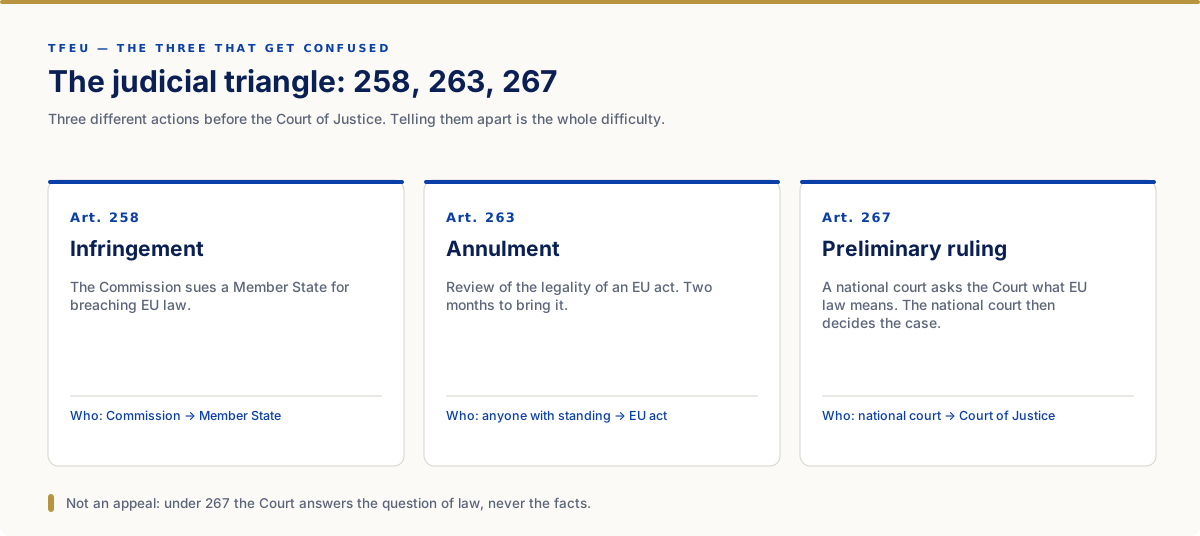
What the questions in our bank actually test
Theory says Article 267 has several moving parts. Our own EU Knowledge bank says candidates meet one of them far more than the rest. Of the 23 active questions that turn on Article 267, 20 test the distinction between may and must — and in 18 of them the correct answer contains the phrase "against whose decisions there is no judicial remedy under national law".
That is a lopsided distribution, and it is worth knowing before you allocate study time. If you can state the last-instance obligation in the treaty's own words and recognise it inside a paraphrase, you have covered most of what this article is asked about.
The distractors repeat too, and they are worth learning as a set because they are all structurally wrong rather than factually close:
- The wrong institution. "The national court may request the European Commission to issue a preliminary ruling." The Commission has no judicial function; only the Court of Justice gives rulings.
- The wrong article. "The procedure is governed by Article 263 TFEU, which allows national courts to challenge the validity of EU acts directly." Article 263 is the action for annulment, brought by privileged and non-privileged applicants — not a channel for national courts.
- The reversed direction. "The Court of Justice may refer a question to a national court." The referral runs upward, never down.
- The over-extended duty. "Any national court that considers a decision necessary must refer." That is the may limb wearing the must limb's clothes — and it is the single most effective distractor on this article, because it quotes real treaty language and changes one verb.
Note what none of them do: invent a fact. Each takes a true element of the article and moves it — to another institution, another article, another direction, another modal verb. That is the house style of the EU Knowledge test, and recognising it is worth more than memorising any single answer.
How it connects to the rest of your syllabus
Article 267 is the judicial safeguard of uniformity; Article 258 is the executive one, letting the Commission pursue Member States that break the rules. One works through national judges bottom-up, the other through the Commission top-down — and pairing them in your notes covers most "who enforces EU law?" questions in one move.
Practise the pattern against real questions in the EU Knowledge hub — free weekly sets, every question grounded in an official source — and slot it into your wider campaign with the EPSO Preparation 2026 complete guide.
Get the free EPSO AD reasoning mock test
A realistic practice PDF — verbal, numerical and abstract reasoning. Enter your email and we send it right away.
Free. No spam. Unsubscribe anytime.