



Ask ten candidates what the European Commission does and you will hear "it runs the EU" — which is exactly the vagueness the EU Knowledge test is built to punish. The precise answer sits in one article: Article 17 TEU, the Commission's constitutional job description, and one of the most quoted provisions in the entire exam syllabus.
This piece belongs to our institutions series, with the three Councils, Article 294 (how laws are made) and Article 258 (how breaches are pursued).
The job description, clause by clause
The consolidated text (OJ C 202) opens with the mission: the Commission "shall promote the general interest of the Union and take appropriate initiatives to that end". Everything else flows from that framing — the Commission is the institution of the whole, where the Council represents governments and the Parliament represents citizens.
Then the operational list, each item exam-ready:
- Guardian of the Treaties. It "shall ensure the application of the Treaties" and of the measures adopted under them, overseeing the application of Union law "under the control of the Court of Justice". The enforcement instrument is the Article 258 infringement procedure.
- Executor of the budget. It executes the budget and manages programmes — the Article 314 procedure decides the numbers; the Commission spends them.
- Executive and coordinator. Coordinating, executive and management functions as laid down in the Treaties.
- External face — with one carve-out. It ensures the Union's external representation, except the common foreign and security policy (where the High Representative and the European Council lead). Questions love deleting that exception.
- Programmer. It initiates the Union's annual and multiannual programming.
Article 17(2) — the right of initiative. Union legislative acts "may only be adopted on the basis of a Commission proposal, except where the Treaties provide otherwise". This is the clause behind everything in the ordinary legislative procedure: Parliament and Council decide, but on the Commission's text.
Independence. The Commission's responsibilities are exercised "completely independently": its members neither seek nor take instructions from any government, institution or body. Commissioners are nationals of Member States, but they are not national representatives — the conceptual distinction that separates the Commission from the Council in every well-written exam question.
Appointment and accountability
The cycle runs on the Parliament's five-year term. The European Council, acting by qualified majority and "taking into account the elections to the European Parliament", proposes the candidate for President; the Parliament elects the candidate by a majority of its component members. The President-elect shapes the college with the Council; the college as a body faces a vote of consent in the Parliament; formal appointment follows by the European Council.
Accountability mirrors appointment: the Commission is responsible to the Parliament, which can bring it down — as a body — through a motion of censure. Individual commissioners answer to the President, who can request a member's resignation.
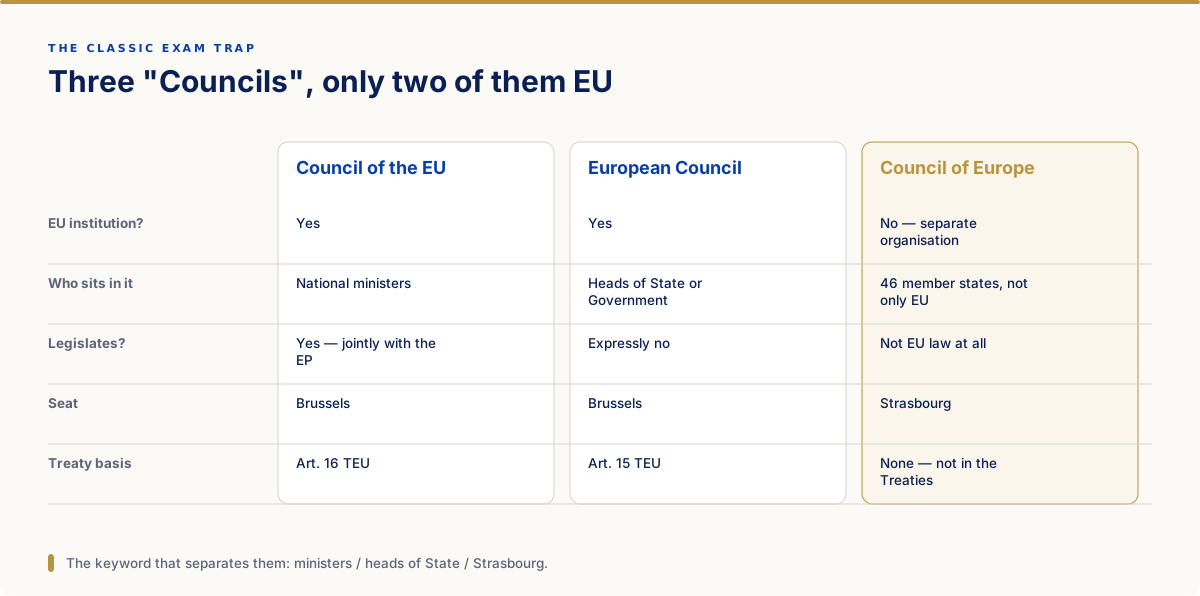
The two articles it sits between
Articles 15, 16 and 17 TEU define three institutions in three consecutive articles, which is exactly why exam questions move an attribute from one to another.
Article 15 — the European Council. Heads of State or Government, plus its President and the President of the Commission. It provides the Union with the necessary impetus for its development and defines the general political directions and priorities. And, in the article's own words, it shall not exercise legislative functions — the most quoted phrase of the three, because it is the cleanest true/false pivot in the institutional syllabus.
Article 16 — the Council. National ministers, and it exercises legislative and budgetary functions jointly with the European Parliament. Co-legislator, not sole legislator.
Article 17 — the Commission. It promotes the general interest of the Union, oversees the application of Union law under the control of the Court of Justice, and — the attribute that gets moved most often — Union legislative acts may be adopted only on the basis of a Commission proposal, except where the Treaties provide otherwise. The right of initiative is the Commission's; a statement that gives it to the Parliament or the Council is testing whether you noticed.
The exam patterns
Function transplants. "The Commission adopts EU legislation" — no: it proposes; the co-legislators adopt. "The Commission represents the Union in the CFSP" — no: that is the carved-out exception. "The Commission defines the Union's political directions" — no: Article 15 TEU gives impetus-setting to the European Council.
Appointment shuffles. Statements electing the President by the European Council alone (the Parliament elects), or subjecting individual commissioners to EP censure (censure is collective).
Independence inversions. Any option in which commissioners "represent their Member State's interests" contradicts the independence clause head-on.
Fix the list — general interest, guardian, budget, executive, external face minus CFSP, initiative monopoly — and test it against free weekly EU Knowledge questions. Campaign-level strategy lives in the EPSO Preparation 2026 complete guide.
Get the free EPSO AD reasoning mock test
A realistic practice PDF — verbal, numerical and abstract reasoning. Enter your email and we send it right away.
Free. No spam. Unsubscribe anytime.