



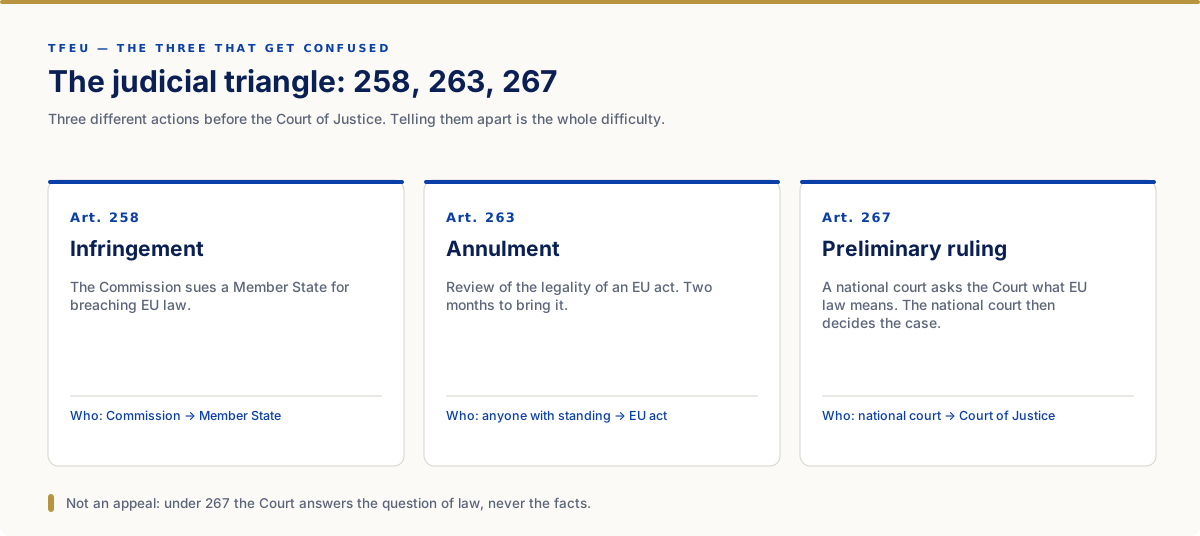
Article 258 polices Member States and Article 267 keeps interpretation uniform — but who polices the EU institutions themselves? That is Article 263 TFEU: the action for annulment, the procedure through which the Court of Justice strikes down unlawful EU acts. It completes the judicial-protection triangle, and the EU Knowledge test treats the trio as one connected syllabus.
What can be annulled
The consolidated text (OJ C 202) gives the Court jurisdiction to "review the legality of legislative acts, of acts of the Council, of the Commission and of the European Central Bank, other than recommendations and opinions, and of acts of the European Parliament and of the European Council intended to produce legal effects vis-à-vis third parties" — plus acts of Union bodies, offices and agencies with such effects.
Two details carry exam weight. The carve-out for recommendations and opinions is pure Article 288 logic: no binding force, nothing to annul. And the "legal effects vis-à-vis third parties" filter explains why internal or purely political acts escape review — the question is always whether the act changes someone's legal position.
The four grounds
Annulment actions must stand on one of four grounds, and the list is worth knowing by heart because EPSO tests it as a list:
- Lack of competence — the institution had no power to adopt the act.
- Infringement of an essential procedural requirement — a mandatory procedural step was violated: the wrong legislative procedure, a skipped consultation, missing reasons.
- Infringement of the Treaties or of any rule of law relating to their application — the broad substantive ground, covering everything from treaty articles to general principles and fundamental rights.
- Misuse of powers — a power exercised for purposes other than those for which it was conferred.
The classic distractor inserts a plausible fifth ground ("manifest error of political judgment", "breach of national constitutional law") or deletes one of the four. If a question shows you this list, count and verify.
Who can sue — the three tiers
Privileged applicants — Member States, the European Parliament, the Council and the Commission — may challenge any reviewable act, no interest required.
Semi-privileged applicants — the Court of Auditors, the European Central Bank and the Committee of the Regions — may sue to protect their own prerogatives.
Non-privileged applicants — natural and legal persons — face the narrow gate: they may challenge acts addressed to them, acts of direct and individual concern to them, and regulatory acts of direct concern not entailing implementing measures (the Lisbon addition that slightly widened the gate). The "individual concern" test is famously strict, which is why the realistic route for individuals against EU-law problems usually runs through national courts and Article 267 — a connection sophisticated exam questions expect you to make.
The clock and the consequence
The action must be instituted within two months of the act's publication, notification, or the applicant's knowledge of it. If the action succeeds, the act is declared void — erased from the legal order, with the Court able to preserve specific effects where legal certainty demands.
The two articles it is confused with
Article 265 — the mirror image. Article 263 attacks something the institutions did; Article 265 attacks something they failed to do. The action for failure to act requires the institution first to be called upon to act, and it is admissible only if the institution has not defined its position within two months of being called upon. A statement that uses Article 263 to compel an institution into action has inverted the pair.
Article 267 — validity from below. Both articles can end with an EU act being found invalid, which is why they blur. The difference is the door. Under 263 an applicant sues directly, within two months, and must clear the standing tiers. Under Article 267 a national court refers the question of validity upward, with no standing requirement on the individual and no two-month clock — because the dispute is a national one and the question of EU law is incidental to it. That is precisely why 267 matters to applicants who could never satisfy the individual-concern test in 263.
The exam patterns
Ground-list manipulation — the invented fifth ground or the missing fourth. Applicant inflation — "any individual may challenge any EU regulation": false; the Plaumann gate stands. Reviewability errors — annulling a recommendation (nothing to annul) or immunising the European Council (its acts with third-party legal effects are reviewable since Lisbon). Deadline drift — six months, one year: no; two months.
Test the triangle — 258 enforces, 267 interprets, 263 annuls — against free weekly EU Knowledge questions, and place judicial protection in your plan with the EPSO Preparation 2026 complete guide.
Get the free EPSO AD reasoning mock test
A realistic practice PDF — verbal, numerical and abstract reasoning. Enter your email and we send it right away.
Free. No spam. Unsubscribe anytime.