


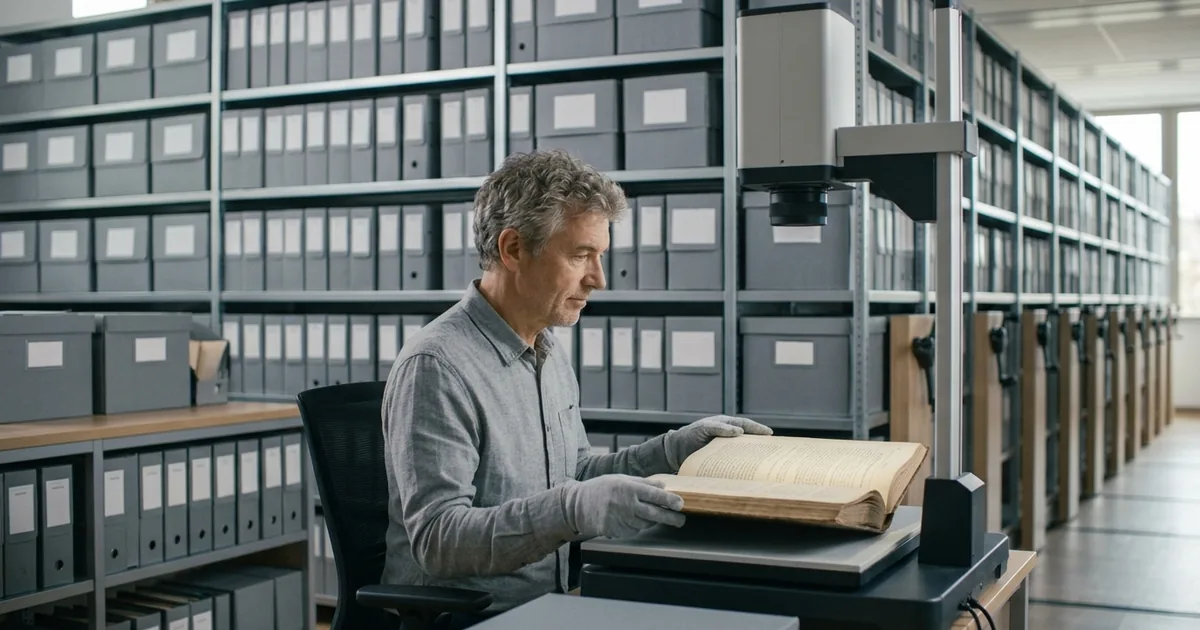
The EU Is Recruiting Archivists at AST 3
EPSO published the notice of competition EPSO/AST/158/26 in the Official Journal on 6 October 2026 (C/2026/4963). It recruits assistants at grade AST 3 in three fields, and field 3 — Records and archives management — seeks 298 successful candidates. The other two fields are data processing, analytics and statistics (423) and librarianship and information science (243). You may apply for one of the three only.
Applications close on 11 November 2026 at 12.00 (midday), Brussels time, on the EPSO competition page. By the same deadline you must upload a scan of a valid identity card or passport; every other supporting document is due by 11 March 2027 at 12.00.
The title EPSO gives the whole procedure — "Data management experts" — hides the fact that this field is classic records and archives work. This guide covers who can apply, how the tests are scored, and what the field-related MCQ draws on.
Who Can Apply
The general conditions are the usual ones: citizenship of an EU Member State with full rights as a citizen, military obligations fulfilled, and the character requirements for the duties. Then two routes, both assessed on the closing date:
- Post-secondary studies of at least two years in a listed area, attested by a diploma, plus at least three years of relevant professional experience gained after that diploma. A diploma in a listed area obtained after a bachelor's in any field — a postgraduate certificate, a master's, a PhD — also meets this requirement, whatever its length.
- Secondary education giving access to post-secondary studies, plus at least six years of relevant professional experience after that diploma.
The listed areas for field 3 are archival sciences and/or records management; information or documentation science or management; digital humanities; history; cultural and/or digital heritage. Business, administration or organisation studies, law, linguistics or literature, international relations and social sciences also count — but only if the studies included a specialisation in one of the first five areas.
Experience is relevant only if it corresponds to the field 3 duties in Annex II. The general rules then pro-rate it: if more than 75% of your tasks in a job were relevant, the whole period counts; more than 50% up to 75% counts at 75%; 25–50% counts at 50%; below 25% does not count. A completed doctorate can count for up to three years. Describe your tasks in the application with that scale in mind.
For the full logic of EPSO eligibility, see our eligibility guide.
The Tests — and the Only One That Ranks You
| Test | Language | Questions | Time | Pass mark | What the score does |
|---|---|---|---|---|---|
| Verbal reasoning | Language 1 | 20 | 35 min | 10/20 | Pass or fail |
| Numerical reasoning | Language 1 | 10 | 20 min | 10/20 combined with abstract | Pass or fail |
| Abstract reasoning | Language 1 | 10 | 10 min | (combined) | Pass or fail |
| Field-related MCQ | Language 2 | 30 | 40 min | 15/30 | Ranking |
| EUFTE (written test on EU matters) | Language 2 | — | 40 min | 5/10 | Pass or fail |
Three consequences follow from the notice.
The field MCQ is the whole contest. Candidates who pass it are ranked in descending order of their score. The EUFTE is marked, and eligibility checked, only for the top of that ranking — in principle no more than 1.5 times the places sought. For field 3 that is around 447 candidates (1.5 × 298), more only if ties at the cut-off require it. Everyone else stops at the MCQ, however good their essay would have been.
It is taken in your second language. The notice requires C1 in one of the 24 official languages and B2 in a different one. Reasoning tests run in Language 1; the field MCQ and the EUFTE both run in Language 2. If you are choosing between two languages for Language 2, choose the one in which you can read archival terminology fastest.
You have 80 seconds a question. Forty minutes for thirty questions. A question that needs you to recall which of two similar rules applies leaves no time to reason it out from first principles; the definitions have to be ready.
Our guides to the field-related MCQ and the EUFTE cover the formats in detail; for the reasoning gates, start with verbal reasoning.
What the Field MCQ Draws On
The notice does not publish a reading list. It publishes twelve typical duties, and it introduces them with one sentence that matters: the duties are carried out "in line with relevant international standards as well as internal rules and procedures and under the supervision of the responsible administrators". That points to two bodies of material — the EU's own rules, and the international standards those rules rely on. What follows maps the duties to the texts that define them; it is preparation guidance, not text from the notice.
Policy, controls and the record lifecycle (duties 1–4)
The Commission's framework is Commission Decision (EU) 2021/2121 of 6 July 2020 on records management and archives, with its Implementing Rules (SEC(2020) 800). Learn its definitions precisely, because Article 3 separates terms that candidates use loosely:
- a record is information received and created as a document, a collection of data or another form, "captured in an official repository and managed and maintained as evidence and as an asset";
- a file is an aggregation of records organised in line with the Commission's activities;
- capture is the insertion of a document into an official electronic repository by combining a unique identifier and metadata.
The Implementing Rules describe capture as a two-stage process performed at the same time: saving the record's metadata in the records management system, and linking the record to that metadata in a permanent and non-modifiable way.
Retention is set by regulatory instruments such as the common retention list (Article 15). The current list, annexed to SEC(2025) 600, gives each file type an administrative retention period and a post-retention action: EL (elimination), SAM/SEL (sampling and/or selection) or THA (transfer to the historical archives), followed where relevant by a second review or PP (permanent preservation). Duty 4 — evaluating business processes to decide what is captured and how long it is kept — is this list in practice.
Preservation and IT systems (duties 3 and 5)
Digital preservation questions rest on the OAIS reference model (CCSDS 650.0-M-2). Two things are worth knowing cold:
- the three information packages: SIP (submission), AIP (archival) and DIP (dissemination);
- the six functional entities: Ingest, Archival Storage, Data Management, Administration, Preservation Planning and Access.
The E-ARK specifications (CSIP, SIP, AIP, DIP) use METS to package OAIS-conformant information packages. For preservation metadata, PREMIS 3.0 builds its data model on Object, Event, Agent and Rights Statement — and the change in version 3 that catches people out: the Intellectual Entity is now a category of Object, alongside Representation, File and Bitstream. MoReq2010 covers the functional requirements of records systems, which is where duty 5 (technical requirements, testing, migrations) lives.
Archival description (duty 6)
Describing archives selected for permanent preservation means ISAD(G), second edition. Its structure is examinable:
- 26 elements in seven areas: identity statement, context, content and structure, conditions of access and use, allied materials, notes, description control;
- a short list of elements considered essential for international exchange: reference code, title, creator, dates, extent of the unit of description, and level of description;
- four multilevel description rules: description from the general to the specific; information relevant to the level of description; linking of descriptions; non-repetition of information.
ISAD(G) sits alongside ISAAR(CPF) for authority records on corporate bodies, persons and families, ISDF for functions and ISDIAH for institutions with archival holdings. The ICA's Records in Contexts conceptual model (RiC-CM) states that it replaces these four standards in one overarching standard.
Security, access and requests (duties 7–9)
Classified information follows Commission Decision (EU, Euratom) 2015/444. The four levels, from highest to lowest: TRES SECRET UE/EU TOP SECRET, SECRET UE/EU SECRET, CONFIDENTIEL UE/EU CONFIDENTIAL, RESTREINT UE/EU RESTRICTED. The records decision adds a rule that links the two worlds: information classified CONFIDENTIEL UE/EU CONFIDENTIAL or higher is not transferred to the Commission's Historical Archives Service (Article 15(3)).
Public access to documents follows Regulation (EC) No 1049/2001. The procedure runs on fifteen working days: the institution answers an initial application within 15 working days of registration; after a refusal the applicant may make a confirmatory application within 15 working days; the institution answers that within 15 working days. In exceptional cases — a very long document, a very large number of documents — the deadline may be extended by 15 working days, with notice and reasons.
Historical archives follow Council Regulation (EEC, Euratom) No 354/83: each institution opens its historical archives to the public after 30 years from the creation of the document. The Commission deposits the archives opened to the public at the Historical Archives of the European Union at the European University Institute in Florence, which is the main access point (Decision 2021/2121, Articles 16 and 18).
Guidance, training and outreach (duties 10–12)
These duties are less about a single text and more about knowing the framework well enough to explain it: the definitions above, who is responsible for what, and why records management protects the institution — the records decision opens by calling records part of the Commission's assets, evidence of action taken and its memory.
Five Pairs That Look Alike
- Two thirty-year rules. Historical archives open after 30 years (Regulation 354/83, Article 1). Separately, under Regulation 1049/2001, an access exception may apply for a maximum of 30 years — with longer protection possible for privacy, commercial interests and sensitive documents (Article 4(7)).
- Document, record, file. A document becomes a record when it is captured in an official repository; a file is an aggregation of records. A question that swaps them is testing Article 3 of the records decision.
- SIP, AIP, DIP. Submission in, archival stored, dissemination out. The AIP is the one the archive preserves.
- Intellectual Entity in PREMIS. Not a separate top-level entity any more: a category of Object since PREMIS 3.0.
- Classified versus historical. The transfer bar in Article 15(3) of the records decision starts at CONFIDENTIEL UE/EU CONFIDENTIAL; RESTREINT UE/EU RESTRICTED is not caught by it.
How to Prepare Between Now and the Tests
- Read Annex II first, then the texts behind each duty. Twelve duties, one or two core texts each.
- Learn the definitions verbatim. At 80 seconds a question, recognition beats reconstruction.
- Practise in your Language 2. Read the records decision and Regulation 1049/2001 in the language you will be tested in; EUR-Lex gives every act in all official languages.
- Do not neglect the gates. A reasoning fail ends the competition before your MCQ is scored. The numerical and abstract tests share a combined pass mark, so a strong abstract score can carry a weaker numerical one.
- Check your candidate account at least every three calendar days, as the general rules require, and keep your EU Login email valid until the reserve list is published.
If an MCQ question looks wrong on the day, you have 3 calendar days from the day after the test to complain through your candidate account; there is no request for review of MCQ results.
The same notice covers two sister fields: data processing, analytics and statistics and librarianship and information science. For how AST grades compare with AD, see our AST competition guide.
Sources
- Notice of competition EPSO/AST/158/26 — OJ C/2026/4963, 6.10.2026
- EPSO competition page
- Commission Decision (EU) 2021/2121 on records management and archives
- Regulation (EC) No 1049/2001 on public access to documents
- Regulation (EEC, Euratom) No 354/83 on the historical archives
- Commission Decision (EU, Euratom) 2015/444 on EU classified information
- OAIS reference model, CCSDS 650.0-M-2
- ICA — ISAD(G), second edition
Everything about eligibility, tests, scoring and deadlines is quoted from the notice of competition. The mapping of duties to legal texts and standards is our preparation guidance.
Get the free EPSO AD reasoning mock test
A realistic practice PDF — verbal, numerical and abstract reasoning. Enter your email and we send it right away.
Free. No spam. Unsubscribe anytime.
Frequently asked questions
- Notice of open competition EPSO/AST/158/26 — OJ C/2026/4963, 6.10.2026 →
- EPSO — Apply for the Data management competition (AST3) →
- Commission Decision (EU) 2021/2121 of 6 July 2020 on records management and archives (OJ L 430, 2.12.2021) →
- Regulation (EC) No 1049/2001 regarding public access to European Parliament, Council and Commission documents →
- Council Regulation (EEC, Euratom) No 354/83 on the opening to the public of the historical archives (consolidated) →
- Commission Decision (EU, Euratom) 2015/444 on the security rules for protecting EU classified information →
- CCSDS 650.0-M-2 — Reference Model for an Open Archival Information System (OAIS) →
- ICA — ISAD(G): General International Standard Archival Description, 2nd edition →