


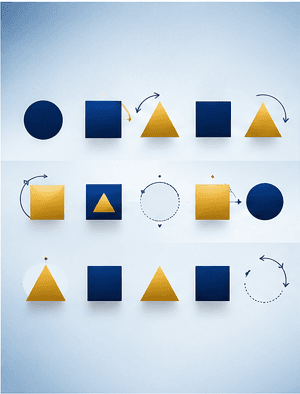
Why Abstract Reasoning Catches Candidates Off Guard
Abstract Reasoning is the most misunderstood component of the EPSO exam. Candidates spend weeks studying EU treaties for the Knowledge test and practising calculations for Numerical Reasoning — but many walk into Abstract Reasoning with no preparation at all, assuming it is either "easy" or "impossible to prepare for."
Both assumptions are wrong.
AR tests a specific skill: the ability to identify visual patterns in sequences of geometric shapes, under significant time pressure. It is not a test of intelligence. It is a test of trained pattern recognition — and like any skill, it improves dramatically with practice.
The 7 Core Pattern Types
Virtually every EPSO Abstract Reasoning question is built on one or more of these pattern categories:
1. Rotation. Shapes rotate by a consistent angle (45°, 90°, 180°) across the sequence. The key is identifying the direction and increment.
2. Reflection. Shapes flip along a horizontal, vertical, or diagonal axis. Often combined with rotation to increase difficulty.
3. Progression. An element changes progressively: growing larger, shrinking, getting darker, or cycling through a set of fills (empty → striped → solid → empty).
4. Element counting. The number of sides, shapes, or dots changes according to a rule — increasing by one, alternating, or following a mathematical sequence.
5. Overlay and combination. Two frames are combined using a logical rule: union, intersection, or XOR (elements that appear in one frame but not the other).
6. Movement along a path. An element moves around the frame — clockwise along corners, bouncing between edges, or following a diagonal path.
7. Conditional rules. "If the shape is black, it rotates 90°. If white, it stays." These multi-rule patterns are the most advanced and typically appear in harder questions.
The Scanning Method
The biggest mistake candidates make is trying to "see" the pattern all at once. This leads to overthinking and wasted time. Instead, use a systematic scanning approach:
Step 1 — Check rotation. Is anything spinning? Look at a distinctive shape and track its orientation across frames.
Step 2 — Check counting. Are elements being added or removed? Count sides, shapes, or dots.
Step 3 — Check movement. Is anything shifting position? Track an element's coordinates across frames.
Step 4 — Check fills and shading. Are colours or fills cycling?
Step 5 — Check combination rules. Are two rows or columns being combined to produce a third?
By scanning in this order, you will identify the pattern type within 15-20 seconds for most questions, leaving the remaining time to confirm and select the correct answer.
Time Management Is Everything
With approximately 1 minute per question (10 questions in 10 minutes), your per-item budget is roughly: scan for 15-20 seconds, decide in 30 seconds, confirm and click in 10 seconds. A useful rule of thumb:
- If you do not see the pattern within 40 seconds, flag it and move on. Return to flagged questions only after completing the rest.
- Never leave a question blank. There is no negative marking on EPSO tests. Always select your best guess before moving on.
- Remember the combined gate. AR shares its 10/20 pass/fail threshold with Numerical Reasoning. Banking easy AR points fast protects you against tougher NR items.
- Trust your first instinct on easy questions. Changing answers under time pressure usually makes things worse, not better.
How to Train
AR is the most trainable EPSO component because it requires no content knowledge — only reflexes. A focused 2-3 week training period is enough for most candidates:
Week 1: Learn to recognise each of the 7 pattern types. Practice untimed, focusing on accuracy and understanding why each answer is correct.
Week 2: Practice timed sets of 10 questions. Your goal is to bring your average comfortably under 1 minute per question while maintaining 70%+ accuracy.
Week 3: Full-length timed simulations — either AR alone (10 questions in 10 minutes) or, ideally, the full combined block (20 NR+AR questions in 30 minutes) to train the pacing of the real pass/fail gate. Focus on the flagging strategy — learning when to move on is as important as knowing the patterns.
The candidates who perform best on AR are not those with the highest natural ability — they are those who trained their scanning reflexes until pattern recognition became automatic.
Get the free EPSO AD reasoning mock test
A realistic practice PDF — verbal, numerical and abstract reasoning. Enter your email and we send it right away.
Free. No spam. Unsubscribe anytime.