



The Path Most Candidates Overlook
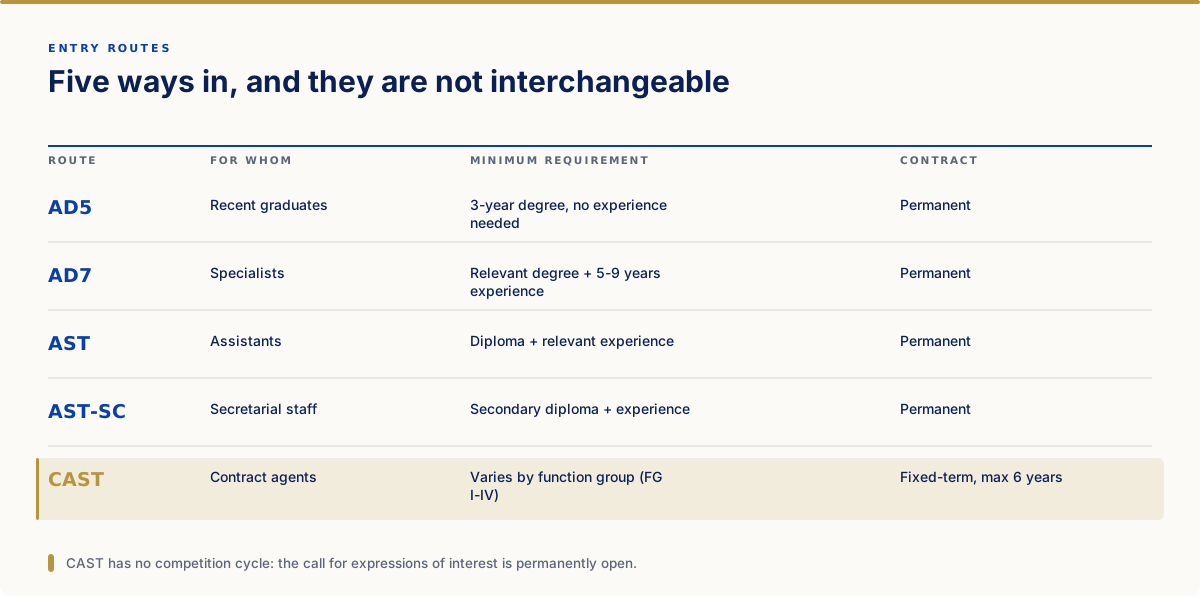
When people think of EU careers, they think of AD (Administrator) positions — policy officers, legal advisors, economists. But EU institutions employ thousands of AST (Assistant) officials in roles that are essential to institutional operations: project coordinators, financial assistants, IT technicians, secretaries, and technical specialists.
AST competitions are less visible than AD competitions, attract smaller candidate pools, and have more accessible entry requirements. For many candidates, this is the most realistic — and most overlooked — path into an EU career.
What AST Officials Actually Do
AST positions cover a wide range of responsibilities across EU institutions:
Executive and coordination roles: Managing files, organising meetings, coordinating between units, supporting policy officers with research and documentation.
Financial and accounting roles: Processing payments, managing budgets, handling procurement procedures, financial reporting.
Technical roles: IT support, facilities management, laboratory work, building management, technical maintenance.
Secretarial and administrative roles: Document management, correspondence, scheduling, translation support, event organisation.
These are not junior positions. Senior AST officials manage teams, run significant projects, and carry institutional knowledge that is critical to how EU institutions function.
Entry Requirements
AST competitions have more accessible requirements than AD competitions:
Education:
- Post-secondary education in a relevant field (duration varies by Notice of Competition), OR
- Secondary education (equivalent to A-levels or Baccalaureate) plus relevant professional experience (typical thresholds vary by NoC)
Always check the specific Notice of Competition for the exact qualifications and minimum durations required, as these change between competitions and roles.
Languages:
- Language 1: any of the 24 official EU languages, at C1 level at least
- Language 2: a different official EU language, at B2 level at least. The recent AST notices (EPSO/AST/156/24, EPSO/AST/157/25 and EPSO/AST/158/26) accept any of the other 23; older ones were stricter — EPSO/AST/154/22 required one of the two languages to be English. Check your notice
Experience:
- Varies by competition. Some AST competitions require professional experience; others do not. Always check the specific Notice of Competition.
The Test Format
AST competitions test the same core reasoning skills as AD competitions, but the format and difficulty may differ:
Verbal Reasoning: Reading passages and determining whether statements are true, false, or cannot be determined. The passages may be shorter or less technical than AD-level passages.
Numerical Reasoning: Interpreting tables and graphs to answer quantitative questions. The mathematical complexity is typically at a practical, workplace-relevant level.
Abstract Reasoning: Identifying patterns in geometric sequences. This component is essentially identical across AD and AST competitions.
Some AST competitions include additional components depending on the profile — for example, organisational and prioritisation skills tests for secretarial profiles, or field-specific questions for technical profiles.
As of October 2026, the AST competition taking applications is EPSO/AST/158/26: 964 AST3 places in data and statistics, librarianship, and records and archives, with applications until 11 November 2026. EPSOmetro's guide to EPSO/AST/158/26 sets out its eligibility, its five tests and which one ranks you.
Salary and Benefits
AST salaries are lower than AD salaries but remain highly competitive compared to national public and private sector equivalents:
| Grade | Basic Monthly Salary |
|---|---|
| AST 1 | €3,291.94 (step 1) |
| AST 3 | €4,214.15 (step 1) |
| AST 5 | €5,394.73 (step 1) |
| AST 7 | €7,876.27 (step 1) |
| AST 9 | €10,082.77 (step 1) |
| AST 11 | €12,907.41 (step 1) |
Source: OJ C/2025/6564, in force since 1 July 2025.
On top of the basic salary, AST officials receive the same allowances as AD officials:
- Expatriation allowance: 16% of basic salary, household allowance and dependent child allowance (per Annex VII Art. 4)
- Household allowance: for officials with dependents
- Child allowance and education allowance: for each dependent child
- EU pension: accrued at 1.8% per year of service, separate from any national pension
- Health insurance: EU institutional health insurance covering the official and dependents
- Annual leave: 24 working days minimum, plus EU institutional holidays
AST vs CAST: Understanding the Difference
AST and CAST (Contract Agent) positions are sometimes confused, but they are fundamentally different:
AST officials are permanent staff. They pass an EPSO competition, are placed on a reserve list, and are recruited as officials with career-long employment rights, pension accrual, and promotion prospects.
Contract agents are hired on fixed-term contracts (typically 3-5 years, sometimes renewable). They do not go through the same competition process and have different employment terms.
If you are considering a long-term EU career, the AST path offers significantly more stability and better long-term benefits than contract agent positions.
Career Progression
The AST career path runs from AST 1 to AST 11, with biennial step increases within each grade and promotion to higher grades based on performance and seniority.
AST/SC function group: A related category (AST/SC 1-6) exists for clerical and secretarial roles, with a shorter progression ladder.
Internal mobility: AST officials can change units, DGs, and even institutions. Internal mobility is actively encouraged and opens access to different policy areas and working environments.
Transition to AD: While not guaranteed, several pathways exist for AST officials to move to the AD function group, including internal competitions and certification procedures.
Who Should Consider AST
AST competitions are particularly well-suited for:
- Candidates with strong professional experience but without a 3-year university degree
- Technical specialists (IT, facilities, finance) who want EU employment stability
- Candidates who performed well in CAST roles and want to become permanent officials
- Professionals who prefer implementation and coordination over policy analysis
- Candidates from countries where the AST salary represents a significant improvement over local equivalents
The key message: AST is not a consolation prize for those who cannot pass AD. It is a distinct career path with its own value, its own progression, and its own opportunities.
Get the free EPSO AD reasoning mock test
A realistic practice PDF — verbal, numerical and abstract reasoning. Enter your email and we send it right away.
Free. No spam. Unsubscribe anytime.