



The Role Nobody Talks About — But Everyone Depends On
When candidates research EU careers, they focus on AD administrators and policy officers. Search for EPSO preparation advice and you will find hundreds of articles about AD5 competitions, EU Knowledge tests, and Verbal Reasoning strategies. But search for information about AST/SC secretarial positions and you will find almost nothing.
This is a significant gap, because AST/SC roles are among the most accessible entry points into the EU institutions — and the people who fill them are essential to how the entire system functions.
What AST/SC Actually Means
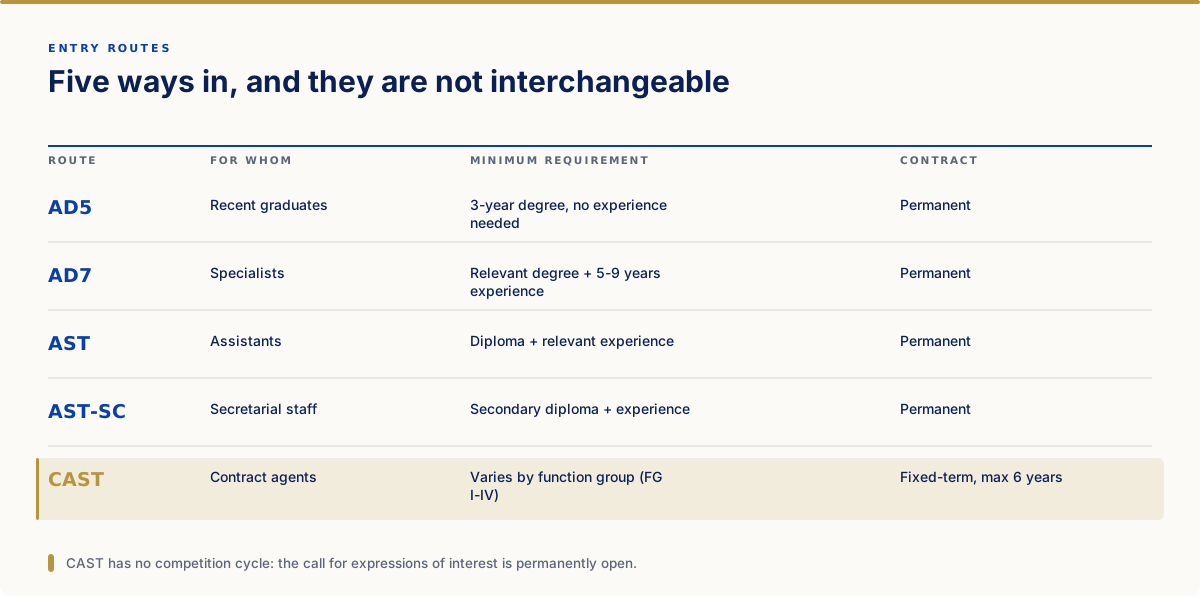
The EU Staff Regulations define four function groups:
- AD (Administrators): policy, legal, economic, and management roles
- AST (Assistants): technical, executive, and implementation roles
- AST/SC (Secretaries/Clerks): secretarial, clerical, and office management roles
- Contract Agents (FG I-IV): fixed-term positions across various functions
AST/SC was created in 2014 as a distinct function group, separating secretarial staff from the broader AST category. It has its own grade structure (SC 1 to SC 6), its own competitions, and its own career progression rules.
Critically, AST/SC officials are permanent staff — they are EU officials with the same employment rights, pension accrual, and institutional benefits as AD administrators. The difference is in the type of work, not in the quality of employment.
What the Job Looks Like in Practice
The title "secretary" does not capture what this role involves in an EU institution. Modern EU secretarial staff are operational coordinators who keep complex institutional machinery running:
Workflow management. Managing the flow of documents through approval chains, tracking deadlines, ensuring procedural compliance. In a Commission Directorate-General, a single AST/SC staff member may coordinate workflows for a unit of 15-30 officials.
Meeting coordination. Organising inter-service consultations, committee meetings, and high-level events. This includes logistics, room bookings, participant lists, document distribution, minute-taking, and follow-up actions.
Multilingual correspondence. Handling incoming and outgoing correspondence in multiple EU languages. Many EU secretarial staff work routinely in 3-4 languages — far more than most professionals outside the institutions.
Mission management. Organising official travel for the unit — approvals, bookings, expense reports, compliance with financial regulations. EU travel procedures are governed by specific rules and require precise administrative handling.
Financial and procurement support. Processing invoices, managing commitments, supporting procurement procedures. EU financial regulations are detailed and specific; secretarial staff who master them become indispensable.
Database and record management. Maintaining institutional databases, filing systems (both digital and physical), and ensuring compliance with document management policies.
Confidential material handling. Many AST/SC staff work with classified or sensitive documents — personnel files, pre-decisional policy documents, diplomatic correspondence. Discretion and security awareness are core competencies.
Entry Requirements
AST/SC competitions have the most accessible entry requirements of any permanent EU position:
Education: Completed secondary education, certified by a diploma giving access to post-secondary education (e.g., Baccalaureate, A-levels, Abitur, Maturità, Bachillerato). No university degree is required.
Professional experience: Experience requirements vary by entry grade. AST/SC 1 typically requires no professional experience (qualifications only), while higher grades — for example AST/SC 2 — typically require around 4 years of relevant experience in secretarial or administrative roles. Always check the specific Notice of Competition.
Languages:
- Language 1: any official EU language
- Language 2: English, French, or German (must be different from Language 1)
Age: No maximum age limit.
The Test Format
AST/SC competitions test core competencies relevant to the role:
Verbal Reasoning. Reading passages and determining whether statements are true, false, or cannot be determined. The passages are drawn from general and institutional contexts.
Numerical Reasoning. Interpreting tables and charts to answer quantitative questions. The focus is on practical, workplace-relevant numeracy — percentages, ratios, trend reading.
Organisational and Prioritisation Skills. This component is specific to AST/SC competitions. You are presented with scenarios involving competing priorities, deadlines, and resource constraints, and must identify the most effective course of action.
Accuracy and Precision test. A distinctive AST/SC component that assesses your ability to detect small differences and errors in data, text, or visual material under time pressure — a core competency for clerical and secretarial work.
Some competitions may also include Abstract Reasoning or field-specific questions depending on the profile.
Important: The difficulty level is calibrated for the AST/SC function group. The reasoning tests are not identical to AD-level tests — they are designed to assess the competencies relevant to secretarial and clerical roles.
Salary and Benefits
AST/SC salaries are lower than AD or AST salaries but remain highly competitive compared to secretarial positions in most EU member states:
| Grade | Basic Monthly Salary (approx.) |
|---|---|
| SC 1 | €2,800 |
| SC 2 | €3,200 |
| SC 3 | €3,600 |
| SC 4 | €4,100 |
| SC 5 | €4,700 |
| SC 6 | €5,400 |
With allowances, total compensation is significantly higher:
- Expatriation allowance: 16% of basic salary (for officials working outside their home country — the majority in Brussels)
- Household allowance: approximately €200/month for officials with a partner
- Dependent child allowance: approximately €420/month per child
- Education allowance: covers school fees for dependent children
- EU pension: 1.8% of basic salary per year of service, separate from national pensions
- Health insurance: EU institutional coverage for the official and dependents
Example: An SC 3 official working in Brussels with one child:
- Basic salary: €3,600
- Expatriation (16%): €576
- Household: €200
- Child allowance: €420
- Total: approximately €4,800/month net (EU salaries have favourable tax treatment)
For comparison, secretarial staff in a national ministry in Italy earn approximately €1,400-1,800/month. In Spain, €1,300-1,700/month. The EU position represents a 2-3x income increase for candidates from Southern and Eastern Europe.
Career Progression
Within AST/SC: Officials progress through biennial step increases (each step adds approximately €100-200/month) and can be promoted to higher SC grades based on merit and seniority. The pace is steady and predictable.
Beyond AST/SC: Several pathways exist to extend your career:
-
Internal competitions. EU institutions periodically run internal competitions that allow AST/SC officials to move to the AST function group (grades AST 1-11). This significantly extends the career ladder and salary ceiling.
-
Certification procedure. Some institutions offer a certification process for experienced AST/SC officials to transition to AST without a full competition.
-
Horizontal mobility. AST/SC officials can change units, Directorates-General, or even institutions. Moving between policy areas — from agriculture to trade to digital affairs — is common and enriches both your CV and your daily work.
Who Should Consider AST/SC
This path is particularly well-suited for:
- Experienced administrative professionals who want EU employment stability and benefits without needing a university degree
- Candidates from Southern and Eastern Europe where the salary differential with national positions is most significant
- Multilingual professionals whose language skills are undervalued in their national labour market
- Career changers looking for a structured entry point into international organisations
- Young professionals with a secondary diploma who want to build a career while colleagues spend years in university — AST/SC officials start earning and accruing pension years immediately
The Competition Landscape
AST/SC competitions are published less frequently than AD competitions, and they attract significantly smaller candidate pools. While an AD5 generalist competition drew 174,727 applicants, AST/SC competitions typically attract a few thousand candidates — creating much more favourable odds.
However, this also means opportunities are less frequent. When an AST/SC competition is published on the EU Careers portal, candidates who are ready to apply immediately have a significant advantage over those who need to start preparing from scratch.
A Note on Perception
There is an unfortunate perception — both inside and outside the institutions — that secretarial roles are "lesser" positions. This perception is wrong and outdated.
EU secretarial staff who excel at their roles are among the most valued members of any unit. They hold institutional memory, manage critical processes, and keep operations running when everyone else is focused on policy content. Senior officials consistently say the same thing: good secretarial staff are irreplaceable.
The AST/SC path offers permanent employment, EU-level benefits, a genuinely international working environment, and the satisfaction of being at the operational heart of European governance. For candidates with the right profile, it deserves far more attention than it receives.
Get the free EPSO AD reasoning mock test
A realistic practice PDF — verbal, numerical and abstract reasoning. Enter your email and we send it right away.
Free. No spam. Unsubscribe anytime.