



Every year, thousands of people discover the same frustrating fact: the EPSO competition they want has no open Notice, and the next cycle is months away. What most of them never learn is that the institutions run a second door that never closes. CAST Permanent has no deadline, no annual cycle and no ranking battle against 170,000 graduates — and for many candidates it is the fastest realistic route to a desk inside the EU institutions.
This guide covers how CAST actually works end to end: the standing call, the function groups, the three tests with their verified formats, the two rules that shape all strategy (10-year validity, six-month lockout), and how to use CAST as both a career route and a stepping stone. Format figures come from the CAST Call for Expression of Interest and EPSO's official testing pages; your invitation letter always prevails. For the wider map of all three entry routes, start with the EPSO Preparation 2026 complete guide.
What CAST is — and what it is not
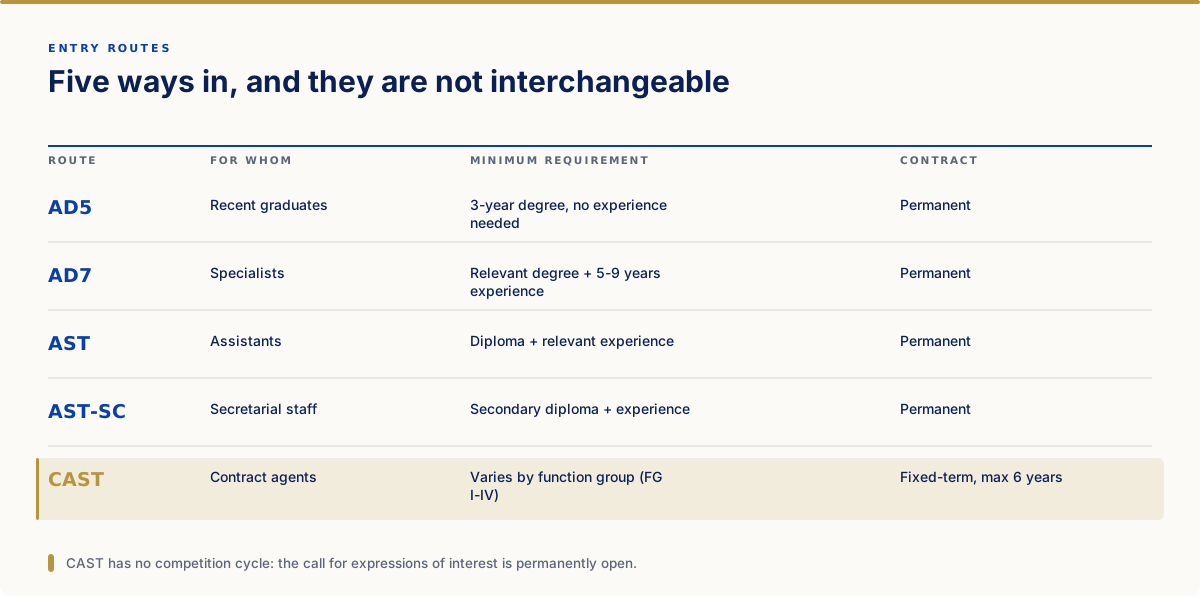
CAST stands for Contract Agents Selection Tool. Unlike competitions, which recruit permanent officials through ranked reserve lists, CAST selects contract agents: staff on fixed-term contracts across the Commission, the agencies, the delegations and the other institutions. The word Permanent in "CAST Permanent" refers to the call being permanently open — not to the contracts.
The structural differences from a competition decide everything about how you should approach it:
| CAST Permanent | EPSO competition (AD/AST) | |
|---|---|---|
| Opens | Always — standing Call for Expression of Interest | Per Notice of Competition, cyclical |
| Outcome | Pass/fail → database of successful candidates | Ranked reserve list |
| Tests | Reasoning only (VR, NR, AR) in Language 1 | Reasoning + knowledge tests + written test |
| Contract | Fixed-term contract agent | Permanent official |
| Result validity | 10 years | Life of the reserve list |
| You sit the tests when… | A service pre-selects your profile | The competition calendar says so |
The single most misunderstood point: registering is not applying for a job. Your expression of interest puts your profile in a pool. Recruiting services search that pool when they have a post, pre-select profiles, and only then does EPSO invite you to test. No invitation, no tests — which is why the quality of your profile matters as much as your test skills.
Function groups and profiles: where you actually fit
CAST is organised in function groups — FG I through FG IV — bundling roles by responsibility and by the education they require:
- FG I — manual and administrative support service tasks.
- FG II — clerical, secretarial and office management tasks.
- FG III — executive tasks: drafting, accountancy, technical implementation. Typically requires post-secondary education, or secondary education plus experience.
- FG IV — administrative, advisory, linguistic and specialist tasks. The graduate-level group: a university degree is required, and most policy-adjacent contract roles live here.
Within the groups you register for profiles — finance, ICT, law, HR, communication, project management, administration and more. Choose profiles you can defend with your CV, not aspirational ones: services search the database by profile, and a mismatch between your declared profile and your documented experience is the classic reason a promising candidacy silently goes nowhere.
Not sure whether your degree and experience clear the bar? The eligibility requirements guide walks through the formal criteria that apply before anyone looks at your test scores.
How the selection actually unfolds
- You register your expression of interest in your EPSO account, per function group and profile.
- A service pre-selects you for a concrete vacancy — this can happen weeks or years after registering, or never, depending on demand for your profile.
- EPSO invites you to the reasoning tests (remotely proctored, on the TAO platform — the TAO guide covers the logistics).
- You pass → you enter the database of successful candidates, and the recruiting service can proceed with its own interviews and, where relevant, competency tests for the post.
- You are recruited — or other services recruit you later on the strength of the same pass, for up to ten years.
Note what this sequence implies: by the time you are invited, a service is already interested in you. The tests are the last gate, not the first — the opposite of a competition, where testing comes before anyone has looked at your file. It also means your preparation window is unpredictable: the invitation can arrive at any moment, and candidates typically get a limited window to sit the tests. The time to prepare is before the invitation, not after it.
The three tests, verified
The CAST battery is the shortest selection EPSO runs — three multiple-choice reasoning tests, all in your Language 1, in a single remote session:
| Test | Questions | Time | Pass mark |
|---|---|---|---|
| Verbal reasoning | 20 | 35 min | 10/20 |
| Numerical reasoning | 10 | 20 min | combined 10/20 with AR |
| Abstract reasoning | 10 | 10 min | combined 10/20 with NR |
No EU Knowledge test. No field-related MCQ. No essay. The formats are identical to the reasoning gates in AD5 and specialist competitions — same question styles, same timing, same traps — which has a convenient consequence: every hour of CAST preparation is also preparation for any future competition you sit.
What each test demands, in one line each: verbal reasoning is inference under time pressure — the correct statement follows from the passage but never copies it; numerical reasoning is data navigation — tables with distractor columns, percentages and ratios, two minutes per question; abstract reasoning is pattern extraction — rotations, reflections and progressions at a strict minute per question. The deep-dive guides on each hub cover the trap patterns and pacing strategy per test.
The two rules that shape all CAST strategy
The 10-year rule. A pass is valid for ten years and covers the same and lower function groups. Passing FG IV once means a decade of recruitability without re-testing. This transforms the economics of preparation: even if no post materialises immediately, the asset you built keeps paying.
The six-month rule. A fail locks you out of testing for the same or a higher function group for six months. If the service that pre-selected you cannot wait — and most cannot — the vacancy moves on. This is the rule that makes "I'll just wing it and see" the most expensive sentence in CAST: a casual fail can cost you the exact post that motivated you to register.
Together they produce the only sensible strategy: prepare before you are invited, and sit your first attempt at full readiness. Aim for a safe margin above the pass marks — 14+/20 in verbal, comfortably clear of the combined 10/20 gate — rather than scraping by. Since CAST is pass/fail, you do not need perfection; you need reliability under pressure, which is precisely what timed practice builds. A structured 4–6 week block is enough for most candidates who practise daily — the 12-week plan in the pillar guide compresses well; if you work full-time, this schedule fits the same work into 45-minute sessions.
CAST as a career instrument
Two candidate profiles get outsized value from CAST.
The fast-entry candidate. You want to work in the institutions soon, not after a 12-month competition cycle. Contract posts open continuously across the Commission, the executive and decentralised agencies, and the EU delegations. FG IV roles in finance, ICT, law and project management are recurrently in demand — and once inside, you accumulate exactly the institutional experience that permanent competitions implicitly reward.
The strategic candidate. You are targeting AD5 or a specialist competition and treat CAST as infrastructure: registering costs nothing, the preparation is the same reasoning battery, and an invitation gives you a full-pressure rehearsal under real exam conditions — proctoring, TAO interface, clock — before the competition that matters most to you. If nerves are part of your equation, this rehearsal effect is worth more than any anxiety-management technique practised at home.
Both profiles end at the same place: a pass valid for ten years, a foot in the door, and preparation that transfers entirely to the next step. For what that next step earns, see what an EU career actually pays — contract agents are on the same allowance architecture, scaled by group and grade.
Register this week, prepare this month
The CAST sequence rewards early movers: profile registered → preparation done → invitation arrives → you pass at first attempt. Registering takes an evening on your EPSO account. Preparation takes a focused month of free timed practice across the three reasoning tests, then holding your level with the Question of the Day until the invitation lands. When it does, you will be the candidate the six-month rule cannot touch.
Get the free EPSO AD reasoning mock test
A realistic practice PDF — verbal, numerical and abstract reasoning. Enter your email and we send it right away.
Free. No spam. Unsubscribe anytime.