


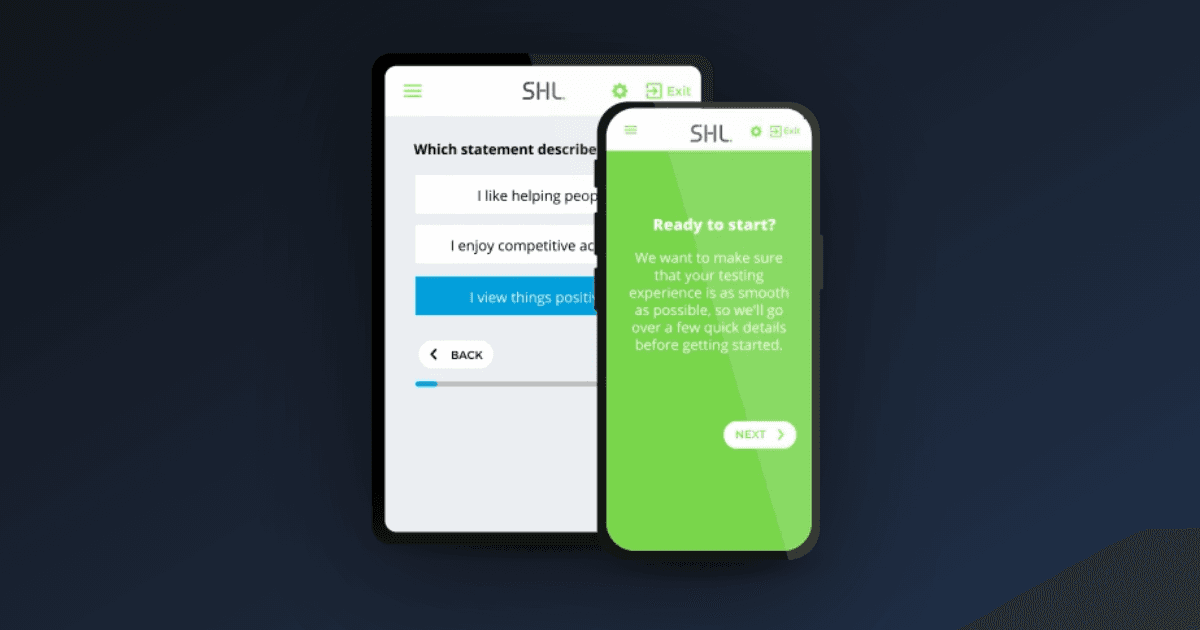
The cognitive test now standing at the gate of the Commission's 2026 internal competitions
If you work at the European Commission and you have your eye on an internal competition in 2026, the format has changed in a way that matters. Instead of opening with an EU-knowledge quiz, the new internal competitions begin with a cognitive reasoning test — an adaptive, interactive assessment run on an external psychometric platform widely identified as SHL. Commercial prep providers such as EU Training and JobTestPrep identify it as SHL Verify Interactive G+, and staff unions point candidates to SHL to practise — though the official notice names only an "external psychometric testing company." Here is exactly what that is, how it works, and how to walk in prepared rather than surprised.
What is SHL Verify Interactive G+, the assessment the format matches?
SHL Verify Interactive G+ is an internet-based cognitive ability test. SHL describes its cognitive assessments as measuring "general mental ability, or G" and your problem-solving and critical-reasoning capabilities. In practice it produces four numbers: a deductive reasoning score, an inductive reasoning score, a numerical reasoning score, and an overall General Ability (G) score that rolls the three together.
The "Interactive" in the name is the important part. This is not a classic multiple-choice paper with options A to E. You solve activity-based tasks — dragging and dropping elements, moving items on screen, and other gamified interactions set in realistic work scenarios — instead of picking one answer from a list.
One honest caveat: the official Notice of Internal Competition refers to an "external psychometric testing company" and does not print the words "SHL" or "Verify Interactive G+." The attribution comes from convergence — unions point staff to SHL practice, and specialist prep vendors publish SHL-specific pages. So treat it as the platform identified as SHL, not as a line copied from the official notice.
The interactive format, section by section
The assessment cycles between three item types across three sections:
- Deductive reasoning — drawing valid conclusions from given rules or premises. Interactive versions can ask you to arrange or rank elements so that a set of conditions all hold at once.
- Inductive reasoning — spotting the pattern in a sequence of shapes or figures and continuing it, often by constructing or completing a figure on screen.
- Numerical reasoning — interpreting data in tables and charts, sometimes by adjusting a graph or manipulating values rather than selecting a printed number.
Because the tasks are built rather than chosen, blind guessing is far less useful than on a five-option MCQ — which is precisely the design intent.
The mechanics: 24 questions, 36 minutes, adaptive, one-way
The interactive version contains 24 questions — fewer than the 30 on the classic multiple-choice edition — spread across the three sections, with roughly eight to ten items each (the product typically selects about eight per sub-test). You get 36 minutes for the 24 timed questions. Before the clock starts, SHL-style tests normally add untimed screens with instructions and a few example questions — commercial prep guides put this at roughly ten minutes, though the official notice doesn't state an exact figure — so allow a little extra time to settle in.
It is adaptive at the item level. Prep providers describe it as SHL's assessment that "adjusts question difficulty in real time based on your responses": answer correctly and the next question gets harder; slip and the next one eases off. This is a form of computer adaptive testing designed to pin down your ability with fewer items.
Two rules shape your strategy. First, there is no negative marking — you earn points for each correct answer, with no deduction for a wrong answer or a question left blank. Second, and this is the trade-off, you generally cannot skip a question or go back; an unanswered item simply scores zero. So a steady, decisive pace beats agonising over any single screen.
How it is scored: percentile against a fixed norm group
This is the point most candidates get wrong, so read it twice. Your raw score is converted into a percentile by comparing you against a fixed comparison group — a norm group of previous test-takers with a similar role profile. You are not ranked against the other people sitting your competition. As analysts of the COM/AD/107/2026 round put it, the difficulty level is set by the exercise designer, not by the other candidates.
A percentile tells you what share of that reference population you outperform. For the Commission's 2026 internal competitions, the published cut-off is the 60th percentile of the relevant reference population — candidates must score at or above it to remain in the process. Because the benchmark is fixed in advance, your job is to clear a known bar, not to outrun the room. (Ignore the "80th percentile" figures some commercial vendors quote for private-sector hiring — that is not the Commission's threshold.)
Where it fits: the 2026 Commission internal competitions
The cognitive test is the first sequential phase. Clear it and you proceed to an EU Knowledge MCQ, then a written test, an eligibility check, and finally an oral test. Three internal competitions currently run on this model:
- COM/AD/107/2026 — AD7 administrators, reserve list of 100. Candidates already sat the cognitive test in June 2026.
- COM/AD/108/2026 — AD5, published 29 May 2026 with a 30 June 2026 deadline, reserve list of 100. The tentative calendar puts the cognitive test and first eligibility checks in September 2026, the EU Knowledge MCQ and written test in October, and the oral in December 2026 / January 2027.
- COM/AST/109/2026 — AST3, applications close 31 July 2026 at 12:00 noon (Brussels time), reserve list of 70, with the cognitive assessment, EU Knowledge MCQ, written test and later an oral.
These are internal: only current Commission staff — permanent officials, temporary agents at AST5 or above, and eligible contract agents with 12+ months of service — can apply.
Don't confuse it with the external EPSO tests
External EPSO general competitions are a different animal. Take EPSO/AD/427/26 (Graduate Administrators AD5 2026): it runs on the TAO platform, remotely and proctored, with verbal reasoning (35 minutes, minimum 10/20), a combined numerical-and-abstract test that only acts as a pass/fail gate, an EU Knowledge MCQ, a digital-skills MCQ, and the EUFTE essay — all classic multiple choice, not SHL interactive. EPSO/AD/428/26 (AD7 Audit, 448 places, window closed 19 May 2026) is likewise an external specialist competition. If your test is A-to-E MCQ in an exam-centre-style flow, you are looking at TAO, not the internal SHL-style assessment.
How to prepare
You cannot revise "general mental ability" the night before, but you can absolutely remove the surprises:
- Rehearse the interactive mechanics — drag-and-drop, ranking, building figures, adjusting charts — so the interface never costs you time.
- Practise all three reasoning types under a strict clock; roughly 90 seconds per item is a realistic budget.
- Train your pacing for a one-way test: commit, answer, move on, and never leave a screen blank.
- Calibrate to the 60th-percentile bar — you need reliable competence across all three sections, not a hero score on one.
Try the format before it counts
The fastest way to know where you stand is to sit the format itself. EU·Now's free demo lets you try 12 interactive questions with no account at eu-now.com/tools/shl-simulator. When you are ready for the full run, the Pass 2026 (€99, one-time, valid through the January 2027 oral) unlocks the complete 24-question / 36-minute simulator with adaptive difficulty selection and a per-section report, in five languages. Walk in knowing the rhythm, the interactions and your own weak spots — that is what turns an unfamiliar test into a manageable one.
EU·Now is not affiliated with SHL Group Ltd or the European Commission. All practice items are original, created in the style of the assessment.
Get the free EPSO AD reasoning mock test
A realistic practice PDF — verbal, numerical and abstract reasoning. Enter your email and we send it right away.
Free. No spam. Unsubscribe anytime.
Frequently asked questions
- SHL — Cognitive Assessments →
- TestHQ — SHL General Ability Test →
- JobTestPrep — EU Commission Tests →
- EU Training — How to Prepare for the COM Internal Competitions 2026 →
- EU Training — What's Coming: July 2026 EPSO Rundown →
- Generation 2004 — New AD5 Generalists Internal Competition Published →
- euemployment.eu — Psychometric Tests (glossary) →
- passEPSO — EPSO AD5 2026 Complete Guide →