



The 2025-2026 Cycle in One Page
The EU institutions are running their largest specialist recruitment cycle in years. Eight specialist fields have either an active competition, a recent reserve list still in use, or an announced upcoming Notice. This page is the index — a single place to compare the fields, their scale, their eligibility, and the dedicated guide for each.
If you are weighing whether to apply to a specialist competition versus the generalist AD5 path, the strategic answer is simple: specialist competitions have much smaller candidate pools relative to reserve list size, but stricter eligibility. Your professional experience becomes your competitive advantage — provided you actually have it.
The Eight Specialty Fields at a Glance
| Field | Priority | Reference NoC | Grade | Reserve list | Status | Guide |
|---|---|---|---|---|---|---|
| IT / ICT / Data Management | P1 | EPSO/AD/426/25 + EPSO/AD/429/26 | AD 7 | 1,020 | Active | Read guide |
| Law | P1 | 2026 Lawyers cycle (6 fields announced) | AD 7 | TBC | Announced | Read guide |
| Audit | P1 | EPSO/AD/428/26 | AD 7 | 448 | Active | Read guide |
| Economics | P1 | EPSO/AD/402/23 | AD 6 | 970 | Reserve list pending publication | Read guide |
| External Relations / EEAS | P1 | EPSO/AD/382/20 + 2026 International Affairs | AD 5/7 | 88 (active) | Reserve list valid until 30 Jun 2026 | Read guide |
| Building Management | P2 | EPSO/AD/425/25 | AD 7 | 411 | Scoring phase | Read guide |
| Communication | P2 | EPSO/AST/157/25 | AST 3 | 435 | Scoring phase | Read guide |
| Human Resources | P2 | EPSO/AST/139/16 (legacy) + CAST FG IV | AST 3 / CA | Legacy 51 | Via CAST FG IV | Read guide |
Priority classification reflects how many EU institutional vacancies the field currently has, not the difficulty of the competition or its strategic value to a candidate. Some P2 fields offer better odds for the right candidate than some P1 ones.
The Common Test Structure
All eight specialist competitions covered here — across AD and AST grades, across fields — use the same post-2024 EPSO model:
| Test | Language | Questions | Time | Pass mark | Counts toward ranking? |
|---|---|---|---|---|---|
| Verbal reasoning | L1 | 20 | 35 min | 10/20 | No |
| Numerical reasoning | L1 | 10 | 20 min | combined 10/20 with AR | No |
| Abstract reasoning | L1 | 10 | 10 min | combined | No |
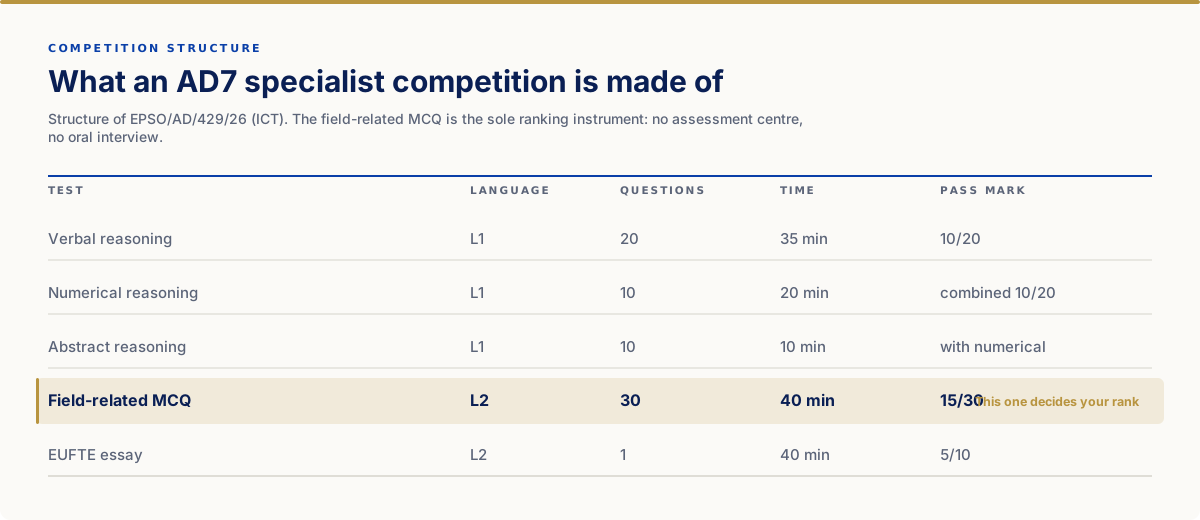
| Field-related MCQ | L2 | 30 | 40 min | 15/30 | Yes — sole ranking |
| EUFTE essay | L2 | 1 | 40 min | 5/10 | No (pass gate only) |
A single online testing day, remotely proctored. No assessment centre. No oral interview. Your FRMCQ score determines your place in the queue; everything else is a filter that lets you stay in the queue.
For the underlying reform that produced this structure, see our EPSO new competition model explainer. For the testing platform you will use, see the EPSO TAO platform guide 2026.
IT / ICT / Data Management (P1)
Two parallel AD7 competitions target 1,020 reserve list places — almost three times the size of the previous EPSO/AD/398/22 cycle. EPSO/AD/426/25 recruits 238 administrators in Data Management and Knowledge; EPSO/AD/429/26 recruits 782 in ICT across four fields (Infrastructure, Project Management, Clouds and Networks, Data Science).
The Data Management Notice is unusually transparent about syllabus content — it names the Data Act, the Open Data Directive, the Data Governance Act, the AI Act, and the GDPR in Annex II as testable territory. The ICT Notice covers operating systems, networking, cybersecurity, DevSecOps, HPC, quantum technologies, MLOps, and data engineering.
→ Full guide: EPSO IT Specialist Competitions
Law (P1)
The 2026 Lawyers cycle is the first substantive EPSO Law NoC since 2019 — a seven-year gap. Two blocks of three fields each: Competition Law, Financial and EMU Law, Litigation Law (traditional Commission Legal Service domains); plus AI Law, Criminal Law, Energy Law (newer regulatory priorities reflecting AI Act enforcement, EPPO expansion, and the Fit-for-55 package).
Critical clarification: lawyer-linguist competitions are linguistic profiles, not substantive Law. The two career tracks are entirely separate. Bar admission is generally not required — a law diploma is sufficient.
→ Full guide: EPSO Lawyer Competition 2026
Audit (P1)
EPSO/AD/428/26 is the largest Audit competition ever — 448 reserve list places versus 60 in the 2022 cycle (a 7.5× increase). The scope has expanded from European Court of Auditors only to all EU institutions, bodies, and agencies. Over 7,000 candidates applied by the deadline.
The Notice does not publish an explicit syllabus list; preparation territory includes the EU Financial Regulation (2024/2509), INTOSAI and COSO frameworks, ECA audit policies, and the budget discharge procedure under Article 319 TFEU.
→ Full guide: EPSO Audit Competition 2026
Economics (P1)
EPSO/AD/402/23 recruited 970 administrators across microeconomics/macroeconomics (300), financial economics (348), and industrial economics (322). The 2024 amendment replaced the case study with the EUFTE and removed the English-only Language 2 requirement.
For senior central-banking economist work, the European Central Bank operates its own selection independent of EPSO via the ECB Graduate Programme — a parallel pipeline with PhD-tilted entry requirements and Frankfurt-based career paths.
→ Full guide: EPSO Economist Competition
External Relations / EEAS (P1)
There is no standalone EPSO diplomatic competition. EU diplomats enter the EEAS through specialist NoCs (External Relations, Crisis Management, International Cooperation) or via Member State diplomat secondments under Article 6(9) of Council Decision 2010/427/EU. The EPSO/AD/382/20 reserve list is valid until 30 June 2026 with 55 AD5 and 33 AD7 administrators available.
Article 6(10) makes mobility statutory: all EEAS staff periodically serve in EU Delegations. The EEAS operates 145 Delegations worldwide and 20 CSDP missions.
→ Full guide: EPSO External Relations & EEAS Careers
Building Management (P2)
EPSO/AD/425/25 targets 411 reserve list places across four engineering fields — Project Management (153), Architecture (75), Electrical Engineering (93), HVAC (90). The reserve list is seventeen times larger than the 2017 EPSO/AD/342/17 cycle, signalling a coordinated staffing-up across OIB, OIL, DG INLO, and the Council Building Unit.
A unique eligibility threshold: candidates must have worked on at least one project of 2,000 m² minimum, or projects totalling 10,000 m² cumulatively. This filters out junior practitioners.
→ Full guide: EPSO Building Management 2026
Communication (P2)
EPSO/AST/157/25 recruits 435 AST3 assistants across Graphic Design (159), Social Media (150), and Webmaster (126). Two flexible eligibility routes — post-secondary diploma plus three years of experience, or secondary education plus six years — make this one of the more accessible EPSO entry points without a university degree.
Critical clarification: there is no parallel AD Communication competition open. AD-level spokesperson and strategic communication roles are filled via DG COMM temporary-staff calls, not EPSO.
→ Full guide: EPSO Communication AST3 2025
Human Resources (P2)
EPSO has not run a dedicated AD-level HR competition in the modern archive, and none is on the 2026 calendar. The last specialist HR NoC was EPSO/AST/139/16 in 2016, producing 51 laureates. Realistic current routes: CAST Permanent FG IV "Administration and Human Resources", the AD5 generalist competition, or institution-specific temporary-agent vacancies.
The Staff Regulations of Officials (Regulation 31/EEC, last consolidated 1 January 2024) are the foundational text for any EU HR professional.
→ Full guide: EPSO HR Recruitment
How to Choose a Specialty Track
Three practical filters:
-
Does your diploma fit? Each Notice lists eligible diploma fields. Some are narrow (Law specialists require a law diploma; Building specialists require architecture or engineering). Others are broad (Data Management accepts ten different diploma families).
-
Do you have the experience years? AD7 specialist competitions require five to seven years of relevant professional experience post-diploma. Without it, target the AD5 generalist or wait until you have it.
-
Is your Language 2 strong enough? The FRMCQ and EUFTE are in Language 2 at B2 level. If your operational reading of EU regulations in your second language is slow, that test will be brutal regardless of how strong your field knowledge is.
For broader EPSO preparation, our 12-week study plan for AD5 applies (with field-specific adjustments) to specialist competitions too. The eligibility documentation review is identical — see the EPSO eligibility requirements complete guide.
What's Next on the EPSO Calendar
Beyond the eight specialty tracks documented above, the 2026 EPSO calendar includes Secretaries, Lawyer-Linguists, Data Managers AST, ICT AST (three sub-fields), International Affairs Specialists AD, Translators, and Nuclear Inspectors. The EPSO competition calendar 2026 tracks publication dates as Notices appear.
For salary expectations across all grades, see our EU career salary guide. For the basic EU institutional structure that defines where reserve list laureates land, see what each EU institution does.
References and Sources
All figures and claims on this page are documented in the eight individual specialty guides linked above. Primary sources include:
Get the free EPSO AD reasoning mock test
A realistic practice PDF — verbal, numerical and abstract reasoning. Enter your email and we send it right away.
Free. No spam. Unsubscribe anytime.