


Why EPSO Changed Everything
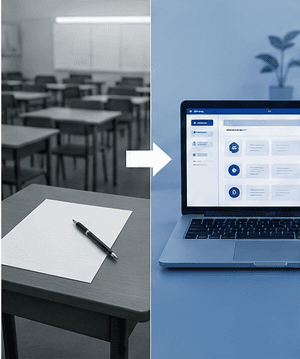
Between 2023 and 2024, EPSO fundamentally redesigned how it selects EU staff. The old model — a two-stage process with Computer-Based Tests followed by an Assessment Centre — had been in place for over a decade. The new model is faster, fully digital, and tests different competencies.
If you prepared for EPSO under the old model, much of what you learned about the process is now outdated. Here is how the new system works.
The Old Model (Pre-Reform)
The previous EPSO competition model had two distinct stages:
Stage 1 — Computer-Based Tests (CBTs). Candidates took Verbal Reasoning, Numerical Reasoning, and Abstract Reasoning tests at Prometric testing centres. These were eliminatory: you had to pass minimum thresholds to proceed.
Stage 2 — Assessment Centre. Candidates who passed the CBTs were invited to Brussels for an Assessment Centre lasting one or two days. This included a case study, a group exercise, a structured interview, and sometimes an oral presentation. Competencies like leadership, communication, and analytical skills were evaluated by trained assessors.
The Assessment Centre was widely considered the most challenging and stressful part of the process. It was also the most expensive for EPSO to administer and the primary bottleneck in time-to-hire.
The New Model (2024 Onwards)
The reformed model replaces the two-stage process (CBT + Assessment Centre) with a single online testing phase delivered entirely on the TAO platform. There is no longer an Assessment Centre for most AD generalist competitions: VR, NR, AR, EU Knowledge, Digital Skills and the EUFTE essay are all part of the same testing phase. The order in which the components are organised, and whether they are taken in one or several sessions, may differ from the list below — EPSO confirms the exact modalities and timings when it invites candidates to the tests. The components are:
1. Verbal Reasoning (VR) — 20 questions / 35 minutes. Read passages and determine whether statements are true, false, or cannot be determined based on the text. Pass mark 10/20 and ~35% of the final ranking (taken in your first language).
2. Numerical Reasoning (NR) — 10 questions / 20 minutes. Interpret tables, graphs, and numerical data to answer quantitative questions.
3. Abstract Reasoning (AR) — 10 questions / 10 minutes. Identify patterns in sequences of geometric shapes.
Note: NR and AR are combined into a single pass/fail gate (10/20 across both). They do NOT count toward your final ranking — they only decide whether you continue.
4. EU Knowledge (EK) — 30 questions / 40 minutes. Test your understanding of EU institutions, treaties, legislative procedures, policies, and current affairs. Pass mark 15/30 and ~25% of the final ranking (taken in your second language).
5. Digital Skills (DS) — 40 questions / 30 minutes. Test your competence across the DigComp 3.0 framework: information literacy, communication, content creation, safety, and problem-solving. Pass mark 20/40 and ~25% of the final ranking (taken in your second language).
6. EUFTE essay — a free-text written test (EU Field Test of Essay). Candidates draft a short structured piece (briefing note, memo, analytical reply) on an EU policy topic. Pass mark 5/10 and ~15% of the final ranking (taken in your second language).
What the Changes Mean in Practice
The Assessment Centre is gone (for most competitions). No more group exercises, no more case studies, no more travelling to Brussels for a high-pressure interview day. This removes a significant source of anxiety and unpredictability from the process.
EU Knowledge now counts toward ranking. Under the old model, EU knowledge was not formally tested (or was tested as a pass/fail Situational Judgement component). Now it is a 30-question test that contributes directly to your total score and ranking. This is a major change: candidates with strong EU institutional knowledge have a new competitive advantage.
Digital Skills are now mandatory. This is entirely new. No previous EPSO competition tested digital competence as a standalone component. Candidates must understand cybersecurity concepts, data management, digital communication tools, and online safety — as defined by the EU's DigComp 3.0 framework.
Everything is online. The shift to the TAO platform means candidates take the exam from approved testing locations using a computer-based interface. Understanding the TAO platform's features is now part of exam preparation.
Strategic Implications
1. Content preparation is more important than before. The old model tested reasoning skills and competencies. The new model tests reasoning skills plus factual knowledge (EU Knowledge, Digital Skills). Pure analytical ability is no longer enough.
2. EU Knowledge is a differentiator. Many candidates with strong reasoning skills neglect EU Knowledge preparation. In the new model, this is a strategic error — 30 questions of factual content can significantly move your ranking.
3. Digital Skills reward systematic study. Because the DigComp 3.0 framework is structured and specific, candidates who study it systematically will outperform those relying on general digital literacy.
4. The process is faster. EPSO has stated that the new model aims to reduce the time from application to reserve list. This benefits candidates who want to move into EU careers quickly.
Adapt Your Preparation
If you are using preparation materials or advice from before 2024, verify that they reflect the new competition model. Key areas to update:
- Remove Assessment Centre preparation (group exercises, case studies) unless your specific competition requires it
- Add EU Knowledge study — treaties, institutions, legislative procedures, key policy areas
- Add Digital Skills study — the DigComp 3.0 framework is your syllabus
- Practice on the TAO platform specifically, not on generic online test interfaces
- Understand the new scoring formula in your Notice of Competition
Get the free EPSO AD reasoning mock test
A realistic practice PDF — verbal, numerical and abstract reasoning. Enter your email and we send it right away.
Free. No spam. Unsubscribe anytime.