

The 2026 EPSO competition in numbers
2026 is a record year for European Union competitions. The EPSO/AD/427/26 call — the classic AD5 for newly graduated administrators — closed applications on March 10 with 174,922 candidates for 1,490 positions (official EPSO data). This is the highest participation in EPSO history. Among these candidates, 45.4% are Italian: 79,450 people, the largest national group. This figure is not surprising — Italy has always been one of the most represented countries in European institutions and among EU competition candidates.
For those who did not apply for the AD5, opportunities do not end here. The AD7 ICT Experts competition (EPSO/AD/429/26) remains open until June 10, 2026, seeking 782 IT experts divided into four sub-fields: project management, data science, infrastructure, cloud & networks. Furthermore, new calls are published periodically for specialist profiles and contract staff (CAST).
This guide covers everything you need to get oriented: requirements, tests, calendar, salaries, and how to prepare effectively.
What does "EPSO competition" mean?
EPSO stands for European Personnel Selection Office — the European office for personnel selection, based in Bruxelles. It is the body that manages selections for all EU institutions: European Commission, Council, Parliament, Court of Justice, Court of Auditors, European Central Bank, decentralized agencies, and the diplomatic service.
EPSO competitions are the standard tool for entering the European civil service with a permanent contract. Alternative paths exist (traineeships, CAST contracts, seconded national experts), but only the EPSO competition leads to "EU official" status — with stability, fixed career progression, and full protections.
Competitions are organized by professional category:
| Category | Profile | Minimum requirements | Starting salary (gross) |
|---|---|---|---|
| AD5 | Graduate Administrator | 3-year degree, two EU languages | ~6,153 € |
| AD7 | Specialist Administrator (ICT, audit, legal…) | Degree + 6 years of experience | ~7,876 € |
| AST | Assistant | Diploma + experience (or professional qualification) | ~3,754 € |
| AST-SC | Secretarial/clerical | High school diploma | ~3,292 € |
| CAST | Fixed-term contract (3-6 years) | Variable by function | Variable |
AD5 2026: the benchmark competition
The AD5 competition is the annual "main event": the gateway for those who have completed university and wish to start a career in EU institutions. The 2026 call has specific characteristics.
Official call: EPSO/AD/427/26 — published on 5 February 2026 in the Official Journal of the EU (OJ C/2026/711).
Total positions: 1,490 — divided into two reserve lists for two general areas: European public administration and EU policy management.
Requirements:
- Citizenship of an EU Member State
- Completed bachelor's degree (or equivalent qualification)
- Thorough knowledge of Language 1: any of the 24 official EU languages (including Italian)
- Satisfactory knowledge of Language 2 (B2 level): for AD5 2026, any of the other 23 official EU languages different from Language 1
No previous professional experience is required — AD5 is explicitly the entry category for recent graduates.
Indicative calendar:
| Phase | Period |
|---|---|
| Publication of the call | 5 February 2026 |
| Closing of applications | 10 March 2026 |
| Tests (reasoning + EU Knowledge + Digital Skills + EUFTE) | Autumn 2026 |
| Publication of the reserve list | 2027 |
| Recruitment by institutions | 2027-2029 |
In the 2026 cycle, all tests take place in a single remote phase (online, with AI proctoring): no in-person assessment centre is planned. After the publication of the reserve list, EU institutions contact eligible candidates for targeted interviews for specific positions. Exact dates are communicated via the candidate account on the EPSO portal.
The five AD5 pre-selection tests
The pre-selection consists of five computerized tests, administered remotely with AI-assisted proctoring (no longer in physical centers). Attention to language is important: the three reasoning tests (verbal, numerical, abstract) are taken in your Language 1, while EU Knowledge and Digital Skills are taken in your Language 2 (a second official EU language, B2 level).
| Test | Questions | Time | Language | Role in the score |
|---|---|---|---|---|
| Verbal Reasoning (VR) | 20 | 35 min | Language 1 | Highest weight in the final score |
| EU Knowledge (EK) | 30 | 40 min | Language 2 | Significant weight |
| Digital Skills (DS) | 40 | 30 min | Language 2 | Significant weight |
| Numerical Reasoning (NR) | 10 | 20 min | Language 1 | Pass/fail gate (combined with AR) |
| Abstract Reasoning (AR) | 10 | 10 min | Language 1 | Pass/fail gate (combined with NR) |
What "pass/fail gate" means: Numerical and Abstract Reasoning form a single combined test of 20 questions. You must achieve a minimum overall score of 10 correct answers out of 20 (NR + AR together) to proceed to the next stages. If you do not pass this threshold, the scores of the other tests are not counted and you are eliminated — NR and AR act as a gate, not an evaluation that improves your ranking.
Verbal Reasoning (VR)
Short passages of text (approximately 100-200 words, on technical, scientific, or EU-related topics) followed by four statements. You must choose the only statement fully supported by the text: the other three contain unsupported information, over-generalizations, or slight deviations from what the passage actually says. The golden rule: the correct answer must be 100% justified by the text, without adding any external knowledge. This test has the highest weight in the final score (approximately 35%) — investing time here is the most profitable preparation decision.
Numerical Reasoning (NR)
Tables or graphs with numerical data (percentages, conversions, indices, absolute values) followed by a calculation question. You have 2 minutes per question — enough if you know what to look for in the table. The challenge is not the mathematics (it is high school level), but the speed of reading the correct data and the ability to perform rapid mental arithmetic without a calculator. Practice proportions, percentage changes, and conversion rates.
Abstract Reasoning (AR)
Sequences of geometric figures (circles, squares, arrows, triangles) in which you must identify the rule linking one element to another and complete the sequence. The test measures non-verbal logical-deductive reasoning. It is short (10 minutes) and based on patterns: those who practice a hundred of them develop reliable intuition.
EU Knowledge (EK)
30 multiple-choice questions on EU institutions, treaties, and policies. The most frequent areas: roles and compositions of the Parliament/Council/Commission/Court of Justice, ordinary legislative procedure, distribution of competences (exclusive/shared), key articles of the TUE and TFUE, EU economic and budgetary policies, enlargement, and external relations. Study materials: TUE, TFUE, "ABC of EU Law" (official EU publication).
Digital Skills (DS)
40 questions on digital skills according to the DigComp 3.0 framework (developed by the European Commission's Joint Research Centre). The five areas of the framework: information search, evaluation and management; communication and collaboration; content creation; safety, wellbeing and responsible use; and problem identification and solving. This is not a technical test (it does not ask you to write code) — it is a test on how to work safely, ethically, and productively with digital tools.
The EUFTE written test
Along with the multiple-choice tests, the 2026 cycle evaluation includes the written test EUFTE — Free-Text Essay on EU matters. It is graded only for the highest-ranking candidates after the tests (in principle, approximately 1.5 times the number of positions on the list), meaning the multiple-choice phase remains the primary filter.
EUFTE is a 40-minute written test, taken online in Language 2. You will receive a set of materials and must produce a working document typical of the EU administration (for example, a briefing note, a policy memo, a press release, or a short analytical report). EUFTE exclusively assesses written communication — it is not a language or knowledge test: it measures how you structure ideas, your conciseness, clarity, adaptation to the target audience, and the effective use of the provided materials. It is scored out of 10 points, with a minimum threshold of 5/10, and accounts for approximately 15% of the final score.
In the AD5 2026 cycle, no in-person Assessment Centre is planned: the entire evaluation takes place remotely during the same testing phase. Final selection for individual positions occurs through interviews conducted by the institutions with candidates from the reserve list.
What to do now — next steps
If you are among the 79,450 Italians applying for AD5 2026, you have about 3-4 months before the autumn pre-selection tests. This is exactly the time needed for a structured preparation.
Weeks 1-2: familiarise yourself with the format of all five tests. Take an untimed diagnostic test for each to record your baseline.
Weeks 3-6: focus on Verbal Reasoning (highest weight) and EU Knowledge (extensive material that requires progressive consolidation).
Weeks 7-9: Digital Skills (DigComp 3.0 framework), Numerical and Abstract reasoning (intensive pattern practice).
Weeks 10-12: full timed simulations, review of weak areas, and EUFTE mock tests for those who want to prepare for the next phase.
You can find detailed guides for each test and a week-by-week study plan in our blog Your 12-week EPSO AD5 study plan.
The truth about the numbers
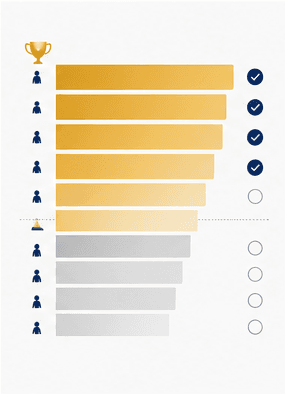
Out of 174,922 AD5 candidates, 6,000-9,000 will pass the pre-selection (a 5-6% filter). Of these, 1,490 will enter the final reserve list after the EUFTE correction — another filter. The overall success rate is therefore less than 1%.
But this is a misleading statistic. The individual probability of passing the competition is not 1% for everyone — it depends almost entirely on preparation. EPSO data shows that the average candidate does not prepare in a structured way: they limit themselves to looking at a few sample tests in the days leading up to it. Those who dedicate 40-60 hours of targeted preparation have significantly higher success rates.
The EPSO competition does not reward innate talent. It rewards familiarity with the format, time management under pressure, and the ability to maintain consistency across five different tests in a few hours. All of these are elements that can be trained.
Official Resources
For your preparation, these are the official sources to consult:
- EU Careers — AD5 2026 competition page
- EUR-Lex — full text of the call for applications in Italian
- EU Careers — test types and official sample tests
- DigComp 3.0 — complete framework
- TUE and TFUE — consolidated versions
All official materials are free and available in Italian. Beware of anyone selling you "the secret to the EPSO competition": the secret is the study framework, not a confidential document.
Get the free EPSO AD reasoning mock test
A realistic practice PDF — verbal, numerical and abstract reasoning. Enter your email and we send it right away.
Free. No spam. Unsubscribe anytime.
Frequently asked questions
- EPSO — AD5 Graduates: 174,922 applications (official figures) →
- EU Careers — Apply for AD5 Graduate Competition 2026 →
- EU Careers — ICT Experts Competition AD7 →
- EU Careers — EPSO tests and selection procedure →
- EUR-Lex — Bando EPSO/AD/427/26 →
- EPSO Annual Activity Report 2024 →
- DigComp 3.0 — The Digital Competence Framework →