


The Scoring System Most Candidates Do Not Understand
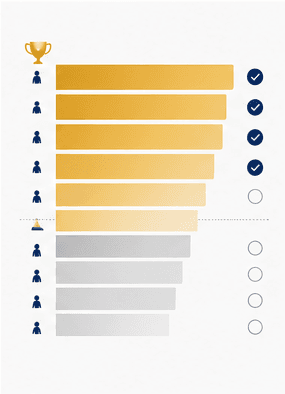
Many EPSO candidates focus entirely on "passing" — reaching the minimum threshold on each test. This is a dangerous strategy. The EPSO scoring system is designed so that passing is only the first gate. The second gate — your ranking against all other candidates — is what actually determines whether you reach the reserve list.
Understanding this distinction is the difference between preparing to survive and preparing to compete.
Gate 1: Minimum Thresholds
Every test component in an EPSO competition has a minimum threshold, typically set at 50% of the maximum score for that component. The exact thresholds are published in the Notice of Competition for each specific exam.
If you score below the threshold on any single component, you are eliminated — regardless of how well you performed on other tests. This means a brilliant EU Knowledge score cannot compensate for failing Numerical Reasoning.
Key implication: You cannot afford a weak area. Your preparation must cover all test types, not just your strengths.
Gate 2: Total Score and Ranking
If you pass all minimum thresholds, your individual test scores are combined into a total score. This total determines your ranking among all candidates who also passed all thresholds.
The Notice of Competition specifies how many reserve list places are available. Only the top-ranked candidates — those with the highest total scores — are placed on the list. Everyone else, despite having passed every individual test, is not selected.
How Weighting Works
Not all test components contribute equally to your total score. EPSO assigns different weights to different tests, and these weights vary by competition type.
For the AD5 2026 generalist competition (EPSO/AD/427/26), the final ranking score is built from only four components: Verbal Reasoning 35%, EU Knowledge 25%, Digital Skills 25%, and the EUFTE field test 15%. Numerical Reasoning and Abstract Reasoning are eliminatory only: you must pass their minimum thresholds, but their scores do not contribute to the final ranking. Exact weightings are always confirmed in each Notice of Competition and can change between competitions.
Strategic insight: A 5-point improvement on a heavily weighted component (like Verbal Reasoning, which carries 35% of the AD5 2026 ranking) contributes far more than a 5-point improvement on a low-weight component. Even more importantly, time spent perfecting Numerical or Abstract Reasoning beyond the pass mark in AD5 2026 returns zero ranking points — but failing either still eliminates you. The optimal strategy is: pass NR and AR safely, then push VR, EU Knowledge, Digital Skills and EUFTE as high as possible.
The Mathematics of Competition
Consider the AD5 2026 competition: 174,727 candidates competing for roughly 1,490 reserve list places. Even if only 40% of candidates pass all minimum thresholds, that is still approximately 70,000 people competing for 1,490 spots — a ratio of roughly 47:1.
In this environment, every point matters. The difference between reserve list position 1,490 and position 1,491 could be a single question answered correctly.
What the Competency Passport Shows
After a competition concludes, EPSO provides each candidate with a competency passport — a document showing their score on each individual component, whether they passed each threshold, and their overall ranking (if applicable).
This document is valuable even if you do not make the reserve list: it shows exactly where your strengths and weaknesses lie, allowing you to prepare more effectively for future competitions.
How to Prepare for Ranking, Not Just Passing
1. Identify the high-weight components in your specific competition's Notice of Competition. Allocate more preparation time to these.
2. Do not settle for "just passing" on any component. Every point above the threshold contributes to your ranking. A score of 7/10 when the threshold is 5/10 is two ranking points better than a score of 5/10.
3. Focus on your weakest areas first. Improving from 4/10 to 6/10 on a weak component is typically easier and more impactful than improving from 8/10 to 9/10 on a strong one.
4. Practice under timed conditions. The difference between knowing the answer and being able to produce it in 35 seconds is what separates candidates at the margin.
5. Review every practice question — including the ones you got right. Understanding why you got a question right is just as important as understanding why you got one wrong. Confident knowledge is faster knowledge, and speed translates directly into points.
Get the free EPSO AD reasoning mock test
A realistic practice PDF — verbal, numerical and abstract reasoning. Enter your email and we send it right away.
Free. No spam. Unsubscribe anytime.