

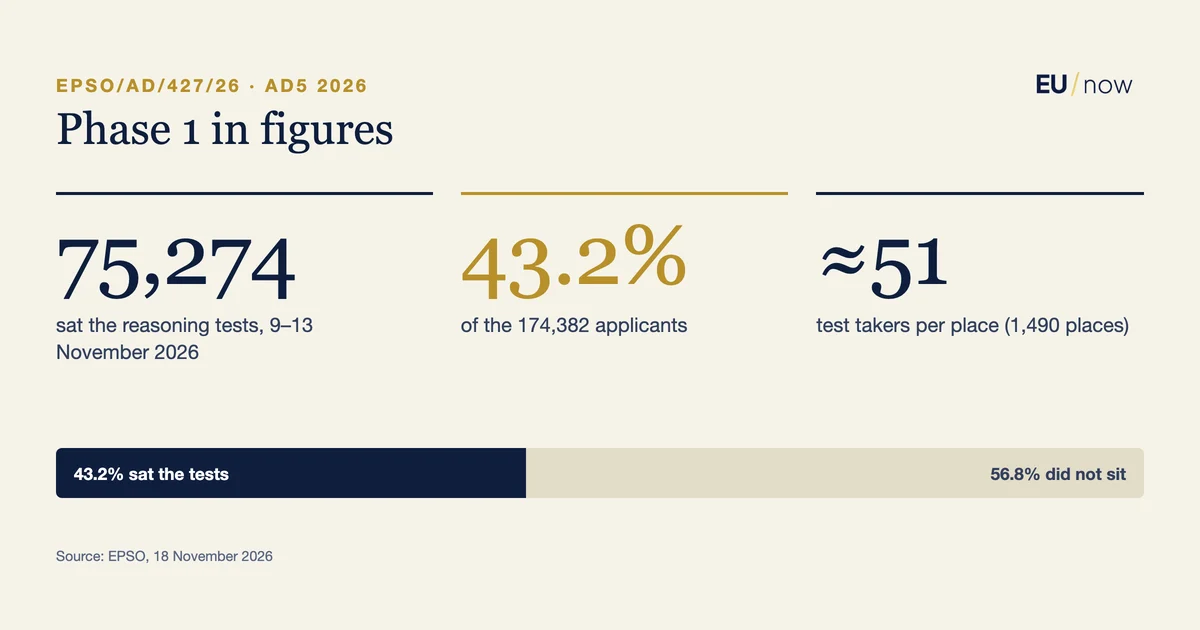
EPSO has published the first hard figures from the AD5 Graduates competition, EPSO/AD/427/26. On 18 November 2026 it reported that 75,274 candidates sat the reasoning tests between 9 and 13 November. That is 43.2% of the 174,382 applicants in its table, and EPSO calls it the largest testing operation it has ever organised.
The same news item explains what happens before anyone gets a result, and when the second phase starts. Here is what the figures say, and what they do not.
Fewer than half of the applicants sat the tests
More than 99,000 applicants did not sit the reasoning tests. EPSO does not break this down, so the figure covers everyone who applied and did not take part, for whatever reason.
For those who did sit the tests, this changes the picture. The notice of competition seeks 1,490 successful candidates. Measured against applicants, that was about 117 people per place. Measured against test takers, it is about 51 per place. It is still a demanding competition, but the field is less than half the size the application figures suggested.
Participation by language
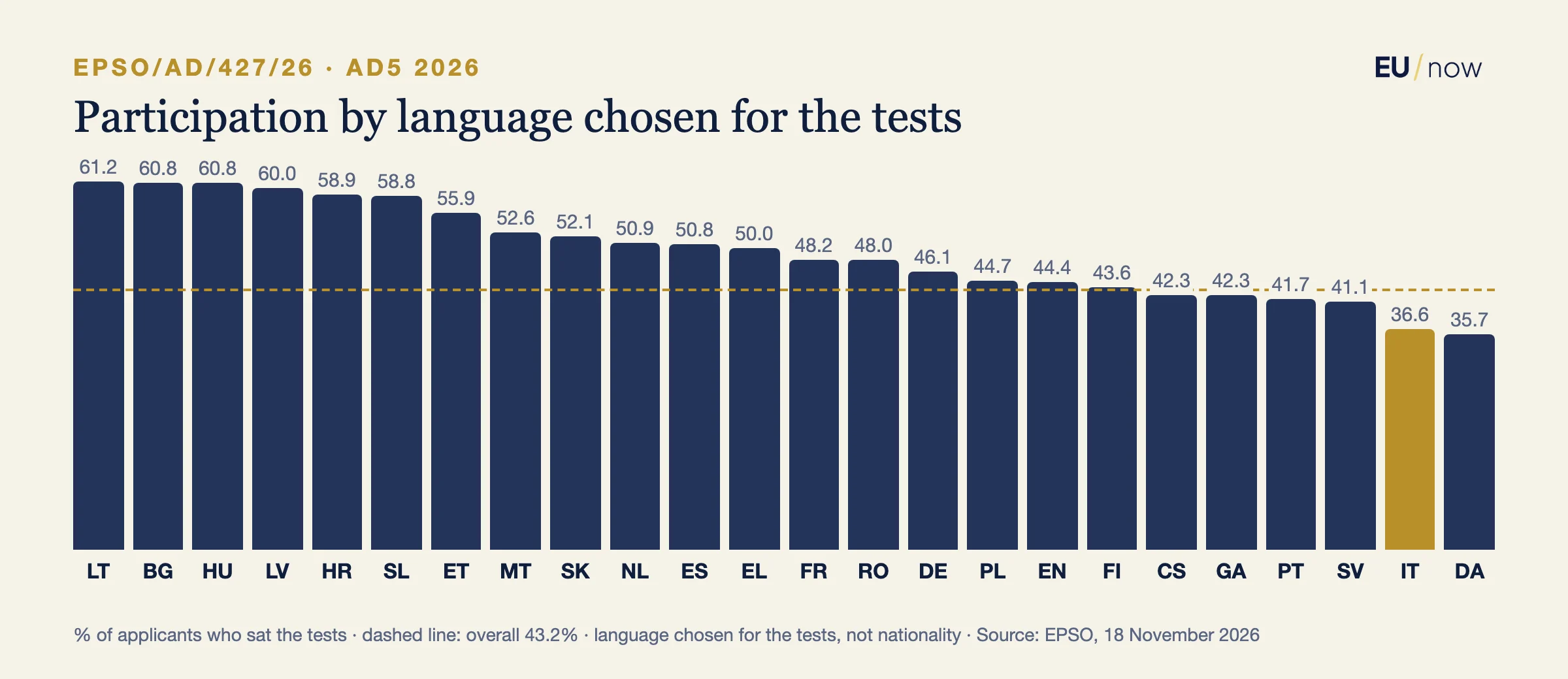
EPSO gave the figures for each of the 24 languages. They refer to the language chosen for the tests, not to nationality.
| Language chosen for the tests | Applicants | Test takers | Participation |
|---|---|---|---|
| Italian | 67,476 | 24,711 | 36.6% |
| English | 27,975 | 12,423 | 44.4% |
| French | 15,624 | 7,530 | 48.2% |
| Spanish | 12,031 | 6,106 | 50.8% |
| German | 10,961 | 5,055 | 46.1% |
| Greek | 8,479 | 4,243 | 50.0% |
| Romanian | 5,691 | 2,732 | 48.0% |
| Polish | 4,762 | 2,129 | 44.7% |
| Portuguese | 4,475 | 1,866 | 41.7% |
| Dutch | 4,225 | 2,150 | 50.9% |
| Finnish | 2,221 | 969 | 43.6% |
| Swedish | 1,584 | 651 | 41.1% |
| Czech | 1,535 | 650 | 42.3% |
| Slovak | 1,241 | 646 | 52.1% |
| Bulgarian | 1,116 | 678 | 60.8% |
| Hungarian | 1,083 | 658 | 60.8% |
| Croatian | 1,079 | 635 | 58.9% |
| Danish | 846 | 302 | 35.7% |
| Lithuanian | 595 | 364 | 61.2% |
| Latvian | 423 | 254 | 60.0% |
| Slovenian | 357 | 210 | 58.8% |
| Estonian | 286 | 160 | 55.9% |
| Maltese | 175 | 92 | 52.6% |
| Irish | 142 | 60 | 42.3% |
| Total | 174,382 | 75,274 | 43.2% |
Three things stand out:
- Italian remains by far the largest group, with the second-lowest participation. Italian accounted for 38.7% of applicants and 32.8% of test takers. Only Danish had a lower participation rate.
- Five languages make up three quarters of the field. Italian, English, French, Spanish and German together account for 74% of test takers.
- Several smaller languages had the highest rates. Lithuanian, Bulgarian, Hungarian and Latvian all reached 60% or more. Not every small language did: Danish and Irish were below average.
EPSO does not explain the differences, and the table cannot tell you why people stayed away. What it does tell you is the real size of the field. The language you chose does not put you in a separate race: there is one competition, and everyone who reaches the reasoning pass marks goes on to the next phase.
When the results come
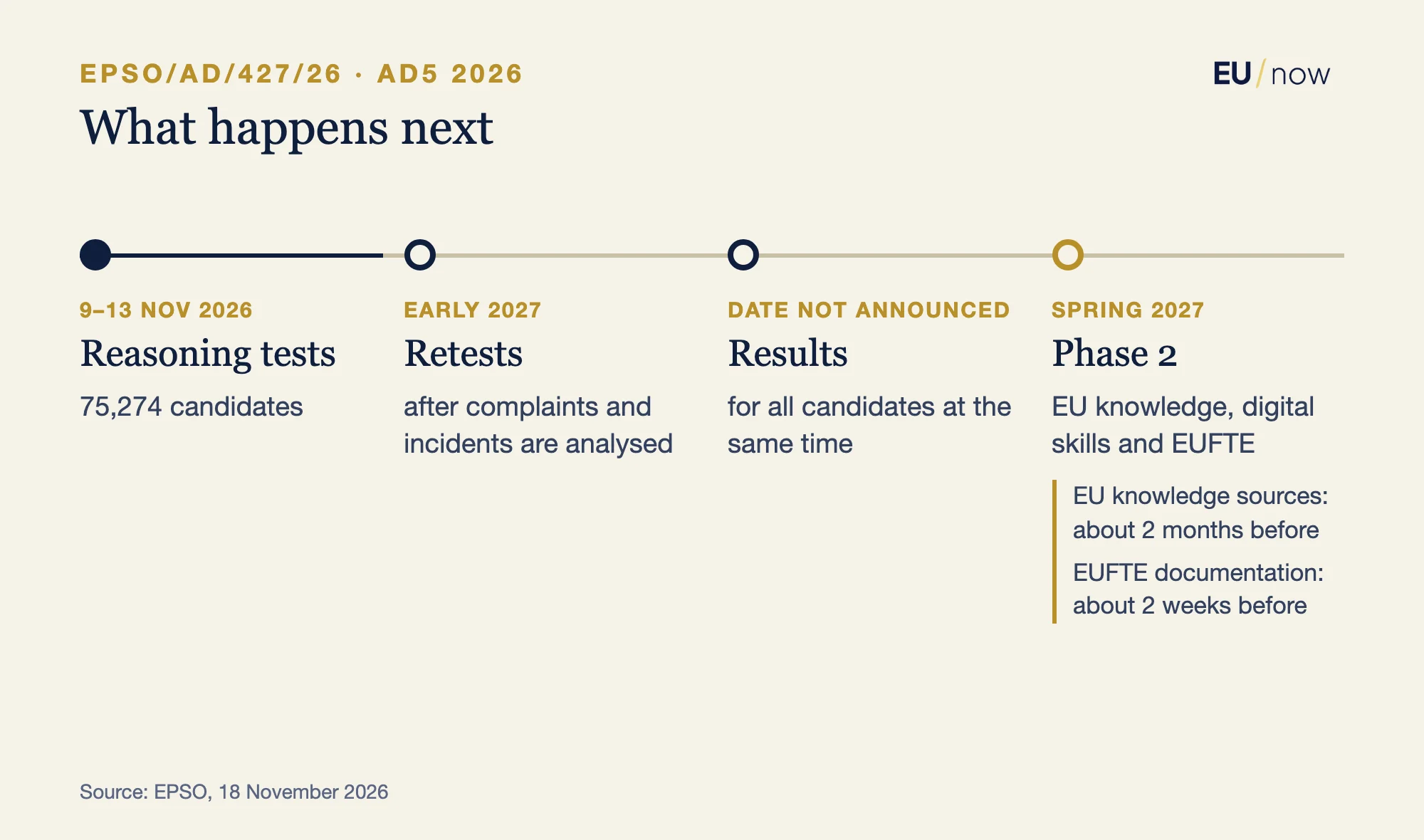
Not yet, and EPSO has not given a date. Before communicating any result it will:
- analyse complaints and reported incidents, to decide whether further investigation is needed;
- assess whether any questions need to be neutralised where legitimate concerns are identified;
- organise the necessary retests, which are planned for early 2027.
To ensure equal treatment, all candidates will receive their results at the same time, once this whole process is complete. EPSO says it will give more information on the timeline in due course.
Neutralising a question has a precise meaning in EPSO's general rules: the Selection Board cancels a question that contains an error and redistributes its points among the remaining questions of that test. Only the candidates who received that question are affected.
What counts from here
The reasoning tests are a filter first. The pass marks are at least 10/20 in verbal reasoning and a combined 10/20 in numerical and abstract reasoning. The notice of competition scores the tests in order (reasoning, then EU knowledge, then digital skills), and each test is scored only for candidates who passed the previous one.
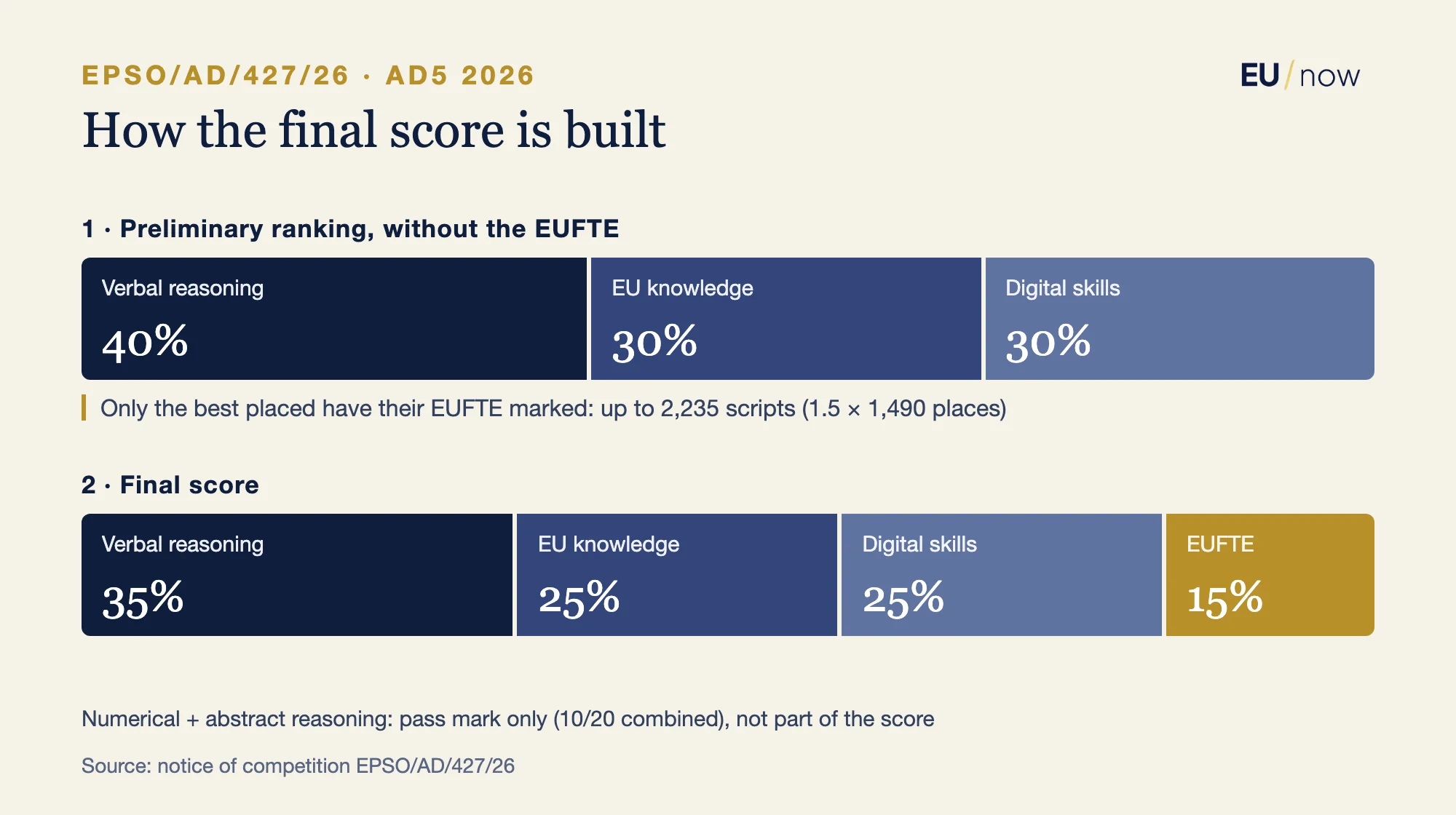
But verbal reasoning is also part of the ranking. The final combined score is made up as follows:
| Test | Pass mark | Weight in the final score |
|---|---|---|
| Verbal reasoning | 10/20 | 35% |
| Numerical + abstract reasoning | 10/20 combined | pass mark only |
| EU knowledge | 15/30 | 25% |
| Digital skills | 20/40 | 25% |
| EUFTE written test | 5/10 | 15% |
The EUFTE scripts are only marked for the best-placed candidates in a preliminary ranking, which leaves the EUFTE out and weights verbal reasoning 40%, EU knowledge 30% and digital skills 30%. In principle, no more than 1.5 times the number of places are marked, which would be 2,235 scripts. The Selection Board may raise that number when candidates tie.
What to do while you wait
Phase 2 is planned for spring 2027: the EU knowledge test, the digital skills test and the EUFTE. EPSO has added two dates to watch:
- About two months before the test, it will publish references to the sources used to write the EU knowledge test.
- About two weeks before the test, it will publish the documentation on which the EUFTE assignment will be based.
Results can only come after the retests planned for early 2027, and Phase 2 is planned for spring 2027, so waiting for your result before you start may leave you little margin. Together, EU knowledge and digital skills are worth half of the final score, and both can be prepared now: see what to study for the EU knowledge test, the digital skills test and DigComp and how the EUFTE works.
A guide for this test. We have written a PDF study guide for the EU knowledge test of the EPSO graduate competition (AD 5), taught from the Treaties and the 13 EU study publications: 22 chapters, 142 questions with every option explained and a full timed test on EPSOmetro. When EPSO publishes the sources it used for the test, we check the guide against them and buyers receive the updated edition free. It is available in English, French, Spanish and Italian. Read 21 pages free.
In EU-now you can practise all three: EU knowledge, digital skills and the written test in exam format, where you read an official EU document first and the task appears only when your 40 minutes start.
For the full timeline of the competition, see AD5 2026 test dates.
Found it useful? Pass it on to someone preparing for EPSO.
Download the free EPSO AD reasoning mock test
A realistic practice PDF — verbal, numerical and abstract reasoning. Enter your email and download it straight away.
Free. No spam. Unsubscribe anytime.
Frequently asked questions
- EPSO — AD5 Graduates: over 75,000 candidates took part in the first testing phase (18 November 2026) →
- EPSO — AD5 graduates first phase testing ended today, with over 95% test completion rate (13 November 2026) →
- EPSO — Graduate administrators, EPSO/AD/427/26 (competition page and notice of competition) →