


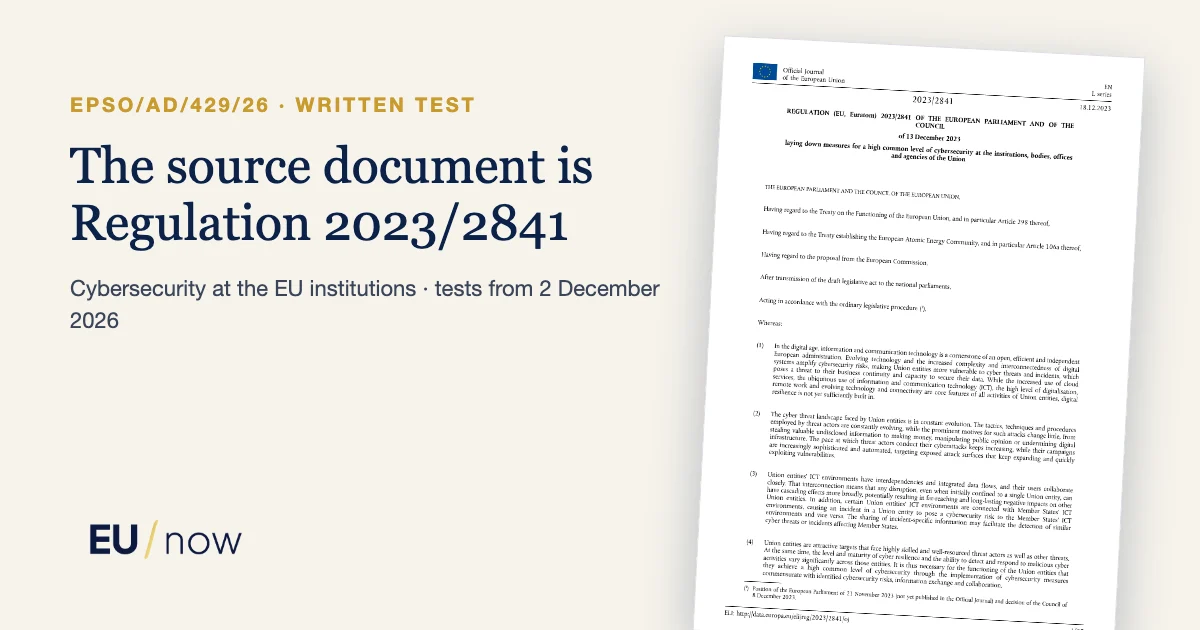
If you applied to EPSO/AD/429/26, the ICT competition at grade AD 7, you now know what your written test will be about. On 19 November 2026 EPSO published the source document: Regulation (EU, Euratom) 2023/2841, which lays down measures for a high common level of cybersecurity at the institutions, bodies, offices and agencies of the Union. It is the same document for all four fields: ICT infrastructure, ICT project management, clouds and networks, and data science.
The testing period starts on 2 December 2026. That leaves less than two weeks to get to know a 27-page legal text well enough to write about it, in your second language, in 40 minutes.
What EPSO has said, and what it has not
The written-test page of the competition is short, and every line matters:
- The test assesses written communication skills. Neither your knowledge of the field nor your knowledge of the topic is assessed, so EPSO says additional research is unnecessary.
- You may make logical assumptions where information is missing or incomplete.
- The hyperlinks that appear in the document are not part of the preparatory material.
- The specific assignment is given on the day of the test, and you will have access to the source document during the test.
What EPSO does not tell you is the task itself, the reader you will write for, or the type of document. The notice of competition sets the frame: the written test is taken in your Language 2, lasts 40 minutes and is marked from 0 to 10, with 5 as the pass mark. It does not rank you; the field-related multiple-choice test does. But you need the pass mark to stay in the competition, so it deserves real practice.
What is in Regulation 2023/2841
The Regulation has six chapters and 26 articles. Read as a map, it answers four questions.
Who has to do what. Every Union entity must set up an internal cybersecurity risk-management, governance and control framework (Article 6), carry out a cybersecurity maturity assessment at least every two years (Article 7), take risk-management measures in at least 16 domains, plus minimum measures such as multifactor authentication as a norm and concrete steps towards zero-trust principles (Article 8), and adopt a cybersecurity plan (Article 9).
Who is responsible. The entity's highest level of management oversees the framework, approves the cybersecurity plan and remains liable even when it delegates specific obligations. A local cybersecurity officer is the single point of contact and reports directly to it (Article 6).
Who watches and helps. The Interinstitutional Cybersecurity Board (IICB) monitors implementation (Chapter III). CERT-EU, the Cybersecurity Service for the Union institutions, bodies, offices and agencies, supports the entities and coordinates the response to incidents (Chapter IV).
What happens when things go wrong. A significant incident must be reported to CERT-EU through an early warning within 24 hours, an incident notification within 72 hours and a final report within one month of the notification (Article 21). If an entity does not comply with the Regulation, the IICB can apply a range of compliance measures, progressively according to the recitals, from a reasoned opinion to, as a last resort, a recommendation to suspend data flows to that entity (Article 12).
| Actor | Main role in the Regulation |
|---|---|
| Each Union entity | Framework, maturity assessments, risk-management measures, cybersecurity plan, incident reporting |
| Highest level of management | Oversees, approves the plan, remains responsible and may be held liable |
| Local cybersecurity officer | Single point of contact; reports directly to the highest level of management |
| IICB | Monitors implementation, issues guidance, applies compliance measures |
| CERT-EU | Supports entities, receives incident reports, coordinates the response to major incidents |
What kind of task to expect
Nobody outside EPSO knows the assignment. What you can do is prepare for the obvious angles. A legal text about obligations, deadlines and responsibilities lends itself to tasks such as briefing a senior manager on what the Regulation requires, explaining reporting obligations under time pressure, advising on how to respond to the IICB, or explaining new security measures to staff in plain language. EPSO's own sample test asks for a briefing note including speaking points, so that format is worth practising first.
Whatever the task, the evaluation rewards the same things: using the information in the document accurately, answering exactly what was asked, a clear structure, concise language and a tone that suits the reader. Copying long passages of the Regulation does none of that.
How to prepare in the time left
- Read it once, end to end, without stopping. The aim is to know where things are: definitions in Article 3, the obligations of each entity in Articles 6 to 9, the IICB in Articles 10 to 12, CERT-EU in Articles 13 to 18, cooperation, reporting and incidents in Articles 19 to 23.
- Read it a second time with one question in mind: who does what, by when. You cannot take notes into the test, so the goal is to know the structure well enough to find a provision in seconds on the day.
- Practise writing on it against the clock: 40 minutes, a role, a reader and a deliverable you did not choose. Then check every figure and every deadline you used against the text.
- Watch the conditions. The Regulation is full of "where appropriate", "where applicable" and "as a last resort". Turning a "may" into a "must" is the easiest way to lose marks for use of information.
Practise on the real document
In EU-now you can rehearse exactly this: four exam-format tasks on Regulation 2023/2841, each asking for a different type of text (a briefing note with speaking points, an email to a Head of Unit, a note to a Secretary-General and an intranet article for staff). You read the document at your own pace, and the task appears only when your 40 minutes start. EUgenio marks your text against the whole Regulation, and when you finish you can compare it with an indicative example in English, French or German. The written-test practice with EUgenio's evaluation is included in the AD and AST plans.
Rehearse the AD/429 written test →
For the format of the written test in general, see our guide to the EPSO EUFTE written test.
Found it useful? Pass it on to someone preparing for EPSO.
Download the free EPSO AD reasoning mock test
A realistic practice PDF — verbal, numerical and abstract reasoning. Enter your email and download it straight away.
Free. No spam. Unsubscribe anytime.