



If you have ever wondered what "digital skills" actually means in an official, measurable sense — not vague buzzwords, but a real, agreed-upon list — the answer has a name: DigComp. It is the European Union's shared language for digital competence, and in November 2025 it received its biggest update in years: DigComp 3.0.
This guide is built in two halves. First, a clear, beginner-friendly tour of what DigComp is, where it came from, why it exists and how it is put together — everything you need to understand the framework from scratch. Second, a precise breakdown of what changed in DigComp 3.0 compared with the previous version, DigComp 2.2. Whether you are preparing for an EU career, designing a course, or simply curious, by the end you will know this framework better than most people who use it daily.
What is DigComp?
DigComp is the European Digital Competence Framework — the European Commission's official description of what it means to be digitally competent. Think of it as a common vocabulary. Instead of every country, employer and training provider inventing their own idea of "digital skills," DigComp gives everyone one shared map.
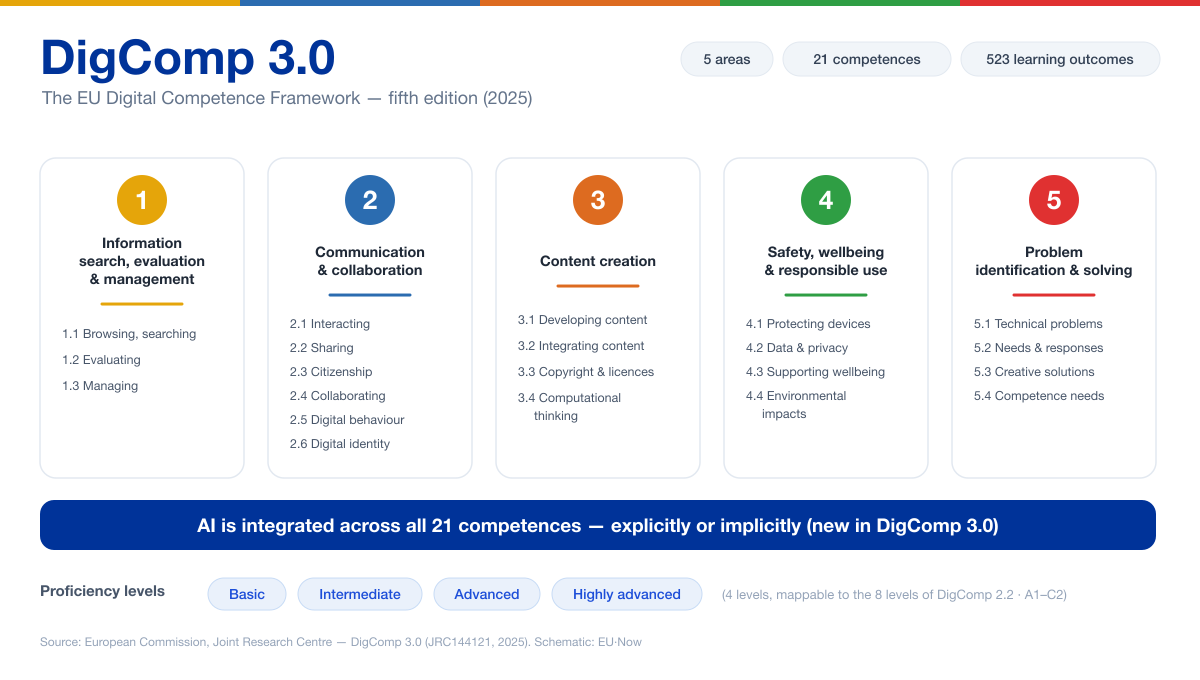
That map answers a deceptively simple question: what does a digitally capable person actually know and do? DigComp's answer is organised into five areas of competence, broken down into twenty-one specific competences, each described across several levels of proficiency from beginner to expert.
Three things make DigComp distinctive:
- It is technology-neutral. It never says "learn this app" or "use that website." It describes capabilities — like evaluating information or protecting your devices — that stay relevant as tools change.
- It is comprehensive. It goes well beyond "using a computer." It includes communicating respectfully online, protecting your privacy, creating content, thinking computationally, looking after your wellbeing in digital environments, and more.
- It is a starting point, not a rulebook. DigComp is non-prescriptive: it is designed to be adapted to whatever you need — a school curriculum, a job profile, a certification, or a self-assessment.
The official definition of digital competence — unchanged for years and still used in DigComp 3.0 — describes it as the confident, critical and responsible use of, and engagement with, digital technologies for learning, at work, and for participation in society.
Where DigComp comes from: a short history
DigComp is published by the Joint Research Centre (JRC) — the European Commission's in-house science and knowledge service — in collaboration with the Directorate-General for Employment, Social Affairs and Inclusion (DG EMPL). It was never a one-off document; it has evolved across five editions over more than a decade.
| Version | Year | What it introduced |
|---|---|---|
| DigComp 1.0 | 2013 | The original framework: the first shared description of digital competence in Europe. |
| DigComp 2.0 | 2016 | A revision of the competence areas and competences (the structure we still recognise today). |
| DigComp 2.1 | 2017 | The proficiency levels — eight levels describing progression from beginner to expert. |
| DigComp 2.2 | 2022 | A refreshed set of examples of knowledge, skills and attitudes, including the first examples on artificial intelligence and data. |
| DigComp 3.0 | 2025 | The fifth edition: a learning-outcomes approach and the systematic, transversal integration of AI. |
The thread running through all of them is consistency. Each edition builds on the last rather than tearing it down — which is exactly why the move from 2.2 to 3.0, big as it is, still feels like an evolution rather than a reinvention.
Why DigComp exists: its objectives
DigComp is not an academic curiosity. It does real work across the EU:
- It sets a common benchmark. DigComp is the conceptual basis of the Digital Skills Indicator (DSI), the official measure used to track digital skills across the EU under the Digital Decade Policy Programme. (The headline target: at least 80% of adults with basic digital skills by 2030 — in 2023, only 56% had them. The gap is precisely what DigComp helps close.)
- It guides education and training. Schools, universities and training providers use it to design courses and define what "good" looks like.
- It powers certifications and self-assessment. Tools that certify or measure digital skills are built on DigComp's areas and levels.
- It shapes job profiles. Employers — including the EU institutions — use it to define the digital requirements of roles.
That last point is where DigComp becomes very practical for anyone eyeing an EU career: the framework is the blueprint behind how digital competence is assessed, including in the EU's own selection procedures.
How DigComp is structured
Here is the architecture, from the top down. Once you see the shape, everything else falls into place.
The 5 competence areas
Every competence in DigComp belongs to one of five thematic areas. In DigComp 3.0 they are:
- Information search, evaluation and management — finding information, judging whether it is trustworthy, and organising it.
- Communication and collaboration — interacting, sharing, participating as a citizen, collaborating, behaving well online, and managing your digital identity.
- Content creation — developing and editing content, integrating it, handling copyright and licences, and computational thinking and programming.
- Safety, wellbeing and responsible use — protecting devices and personal data, supporting wellbeing, and understanding the environmental impact of technology.
- Problem identification and solving — spotting and fixing technical problems, matching needs to digital solutions, finding creative solutions, and recognising your own competence needs.
The 21 competences
Each area contains several competences — 21 in total. This is the heart of the framework: the specific, named capabilities.
| Area | Competences (DigComp 3.0) |
|---|---|
| 1. Information search, evaluation and management | 1.1 Browsing, searching and filtering information · 1.2 Evaluating information · 1.3 Managing information |
| 2. Communication and collaboration | 2.1 Interacting through and with digital technologies · 2.2 Sharing through digital technologies · 2.3 Engaging in citizenship through digital technologies · 2.4 Collaborating through digital technologies · 2.5 Digital behaviour · 2.6 Managing digital identity |
| 3. Content creation | 3.1 Developing digital content · 3.2 Integrating and re-elaborating digital content · 3.3 Copyright and licences · 3.4 Computational thinking and programming |
| 4. Safety, wellbeing and responsible use | 4.1 Protecting devices · 4.2 Protecting personal data and privacy · 4.3 Supporting wellbeing · 4.4 Environmental impacts of digital technologies |
| 5. Problem identification and solving | 5.1 Identifying and solving technical problems · 5.2 Identifying needs and digital technological responses · 5.3 Identifying creative solutions using digital technologies · 5.4 Identifying and addressing digital competence needs |
Proficiency levels
Knowing which competences exist is half the picture. The other half is how well you can perform them. DigComp 3.0 describes four levels of proficiency, based on the complexity of the task, the cognitive demand, and how much autonomy you have:
| Level | What it looks like |
|---|---|
| Basic | You remember and carry out simple tasks, with guidance as needed. |
| Intermediate | You handle well-defined tasks and solve well-defined problems on your own. |
| Advanced | You assess and apply solutions to a variety of complex tasks, adapting to different situations and guiding others. |
| Highly advanced | You resolve highly complex or specialised problems and create new solutions, leading and guiding others. |
Competence statements and learning outcomes
DigComp 3.0 adds two more granular layers beneath the competences — and this is one of the genuinely new contributions of the fifth edition:
- 362 competence statements — short, concrete descriptions of what each competence looks like at each of the four levels.
- 523 learning outcomes — even more detailed statements of what a person should know, understand or be able to do, each tagged by level and by type (knowledge, skills or attitude).
These layers turn DigComp from a high-level map into something you can actually build a course or an assessment around.
Knowledge, skills and attitudes
Throughout the framework, competence is understood as a blend of three ingredients:
- Knowledge — the facts, concepts and ideas you understand.
- Skills — your ability to carry out processes and use what you know to get results.
- Attitudes — your disposition and mindset: how you approach digital technologies, critically and responsibly.
A digitally competent person is not just someone who knows about phishing, but someone who can spot it and who cares enough to act responsibly. DigComp deliberately keeps all three in view.
DigComp and your EU career
If you are preparing for an EU selection procedure, DigComp is more than background reading — it is the blueprint behind the digital skills assessment. The five areas above map directly onto what a digital-skills test is designed to measure: from evaluating online information, to data protection, to using technology responsibly.
That is exactly why we built EU·Now's digital skills practice around the DigComp areas, and why our companion guides go deeper on the test itself: see the complete guide to the EPSO digital skills test and the five fields of digital skills explained. Learn the framework, and you stop guessing what might come up — you know the territory.
What's new in DigComp 3.0 (vs DigComp 2.2)
Now the second half. DigComp 3.0 was shaped by input from around 300 experts and stakeholders across Europe and responds to everything that has changed in technology since 2022 — above all, the arrival of generative AI in everyday tools. Here is what actually changed.
Same skeleton, refreshed language
The most reassuring news first: the structure is intact. Five areas, twenty-one competences, and the very definition of digital competence are all unchanged. If you already know DigComp 2.2, you are not starting over.
What changed is the wording. Four of the five area titles were refreshed, and a number of competences were renamed or had their descriptions rewritten — mostly to remove clutter, improve clarity, and reflect today's reality.
Renamed areas and competences
The area renames:
| # | DigComp 2.2 | DigComp 3.0 |
|---|---|---|
| 1 | Information and data literacy | Information search, evaluation and management |
| 2 | Communication and collaboration | Communication and collaboration (unchanged) |
| 3 | Digital content creation | Content creation |
| 4 | Safety | Safety, wellbeing and responsible use |
| 5 | Problem solving | Problem identification and solving |
And the most meaningful competence renames — the ones that signal a real shift in thinking:
| Code | DigComp 2.2 | DigComp 3.0 | Why it matters |
|---|---|---|---|
| 2.1 | Interacting through digital technologies | Interacting through and with digital technologies | Acknowledges that we now interact with technologies themselves — like AI systems — not just through them. |
| 2.5 | Netiquette | Digital behaviour | A dated term replaced with a broader idea of behaving respectfully online. |
| 3.4 | Programming | Computational thinking and programming | Widens the focus from writing code to the underlying way of thinking. |
| 4.3 | Protecting health and well-being | Supporting wellbeing | A shift from a defensive "protect" to a positive, balanced "support." |
| 4.4 | Protecting the environment | Environmental impacts of digital technologies | Names the real issue: the footprint of devices, data centres and energy use. |
| 5.4 | Identifying digital competence gaps | Identifying and addressing digital competence needs | From spotting a "gap" to actively doing something about your "needs." |
Area 1's competences were also simplified: "data, information and digital content" became simply "information," now used as the umbrella term. And across Area 5, every competence now begins with "Identifying" — a subtle but telling move from "can you use the tool?" to "can you spot the problem and choose well?"
From eight levels to four
DigComp 2.1/2.2 used eight proficiency levels, grouped into four bands (Foundation, Intermediate, Advanced, Highly specialised). DigComp 3.0 simplifies this to four named levels: Basic, Intermediate, Advanced and Highly advanced. The underlying meaning is identical; the framework just speaks more plainly now.
Crucially, the old and new systems are designed to map onto each other, so nothing built on the eight-level scheme is lost:
| DigComp 3.0 (4 levels) | DigComp 2.2 (8 levels) | A1–C2 scheme (6 levels) |
|---|---|---|
| Basic | 1–2 | A1, A2 |
| Intermediate | 3–4 | B1, B2 |
| Advanced | 5–6 | C1 |
| Highly advanced | 7–8 | C2 |
Brand-new: learning outcomes
This is arguably the single biggest addition. DigComp 3.0 introduces 523 learning outcomes — detailed, actionable statements of what a learner should know, understand or be able to do, each written in a consistent "verb + object" style (based on Bloom's taxonomy) and tagged by level and by knowledge / skills / attitude.
| Learning outcomes by level | Share |
|---|---|
| Basic | 29% (151) |
| Intermediate | 32% (170) |
| Advanced | 23% (119) |
| Highly advanced | 16% (83) |
By type, 42% relate to knowledge, 38% to skills and 20% to attitudes. There are deliberately more outcomes at the lower levels — because that is where most learning happens. Alongside them sit the 362 competence statements mentioned earlier. Together they give DigComp a level of practical detail it never had before. (In the process, two older components of DigComp 2.2 — the "examples of knowledge, skills and attitudes" and the "use cases" — were retired, their content folded into the new learning outcomes.)
AI is now everywhere
In DigComp 2.2, artificial intelligence appeared as a set of examples bolted on in 2022. In DigComp 3.0, AI runs through the entire framework. AI-related knowledge, skills and attitudes feature — explicitly or implicitly — across all twenty-one competences.
The framework adopts the AI Act's definition of an AI system and labels every statement and learning outcome as either AI-explicit (AI is directly named) or AI-implicit (AI is relevant in the background — for example, a tool with AI built in, or the need to understand how AI works).
| AI relevance | Competence statements | Learning outcomes |
|---|---|---|
| AI-explicit | 14% | 13% |
| AI-implicit | 68% | 63% |
| No AI | 18% | 24% |
The takeaway: in modern digital competence, AI is no longer a specialist topic off to one side. It is woven into how you search, communicate, create, stay safe and solve problems.
New priorities and a bigger glossary
Five content priorities shaped the update: AI competence, cybersecurity, digital rights and responsibilities, wellbeing in digital environments, and tackling mis- and disinformation — plus a stronger thread on sustainability. The framework also explicitly embodies the values of the European Declaration on Digital Rights and Principles.
To support all this, the glossary grew to around 120 defined terms, introducing concepts that simply were not mainstream in 2022: trustworthy AI, deep-fakes, deceptive patterns (formerly "dark patterns"), the right to disconnect, pre-bunking and de-bunking, and the distinction between disinformation (deliberate) and misinformation (unintentional).
Quick reference: DigComp 2.2 vs 3.0
| Dimension | DigComp 2.2 (2022) | DigComp 3.0 (2025) |
|---|---|---|
| Edition | 4th | 5th |
| Competence areas | 5 | 5 (four renamed) |
| Competences | 21 | 21 (refreshed wording) |
| Proficiency levels | 8 | 4 (Basic / Intermediate / Advanced / Highly advanced) |
| Competence statements | — | 362 |
| Learning outcomes | — (examples only) | 523 |
| Artificial intelligence | Add-on examples | Transversal across all 21 competences |
| Glossary | Smaller | ~120 terms |
| Open data | No | JSON / linked open data |
| Definition of digital competence | — | Unchanged |
What this means if you're preparing for EPSO
You do not need to memorise all 523 learning outcomes. But the shape of DigComp 3.0 tells you where digital-skills assessment is heading:
- AI literacy is now table stakes. Expect questions that assume familiarity with how AI tools work, their risks, and how to use them responsibly — across many topics, not just one.
- Responsibility and judgement matter as much as mechanics. The framework's shift toward "behaving respectfully," "supporting wellbeing" and "addressing needs" mirrors what good assessment rewards: not just can you click the button, but do you make good decisions.
- The fundamentals are stable. Information evaluation, data protection, communication and problem-solving remain the backbone. Solid preparation on the five areas is never wasted.
The smartest move is to learn the framework once, properly — and then practise against realistic questions mapped to each area. That is exactly the approach we take across EU·Now's digital skills preparation.
In short
DigComp is the EU's shared map of digital competence: five areas, twenty-one competences, and a clear sense of what "good" looks like at every level. DigComp 3.0 keeps that proven structure, speaks about it more plainly, adds a rich new layer of learning outcomes, and — most importantly — recognises that artificial intelligence is now part of nearly everything we do digitally. Understand it, and you are not just keeping up with the EU's definition of digital skills. You are ahead of it.
This article is part of EU·Now's Digital Skills knowledge hub. It is verified against the official DigComp 3.0 publication by the European Commission's Joint Research Centre. For the test itself, continue with our EPSO digital skills test guide.
Get the free EPSO AD reasoning mock test
A realistic practice PDF — verbal, numerical and abstract reasoning. Enter your email and we send it right away.
Free. No spam. Unsubscribe anytime.
Frequently asked questions
- JRC — Digital Competence Framework (DigComp 3.0) →
- Cosgrove, J. & Cachia, R. (2025), DigComp 3.0: European Digital Competence Framework — Fifth Edition (Publications Office of the EU, JRC144121) →
- European Commission updates its digital competence framework DigComp (JRC news, 27 Nov 2025) →
- EU Careers — What to know about testing (digital skills) →